
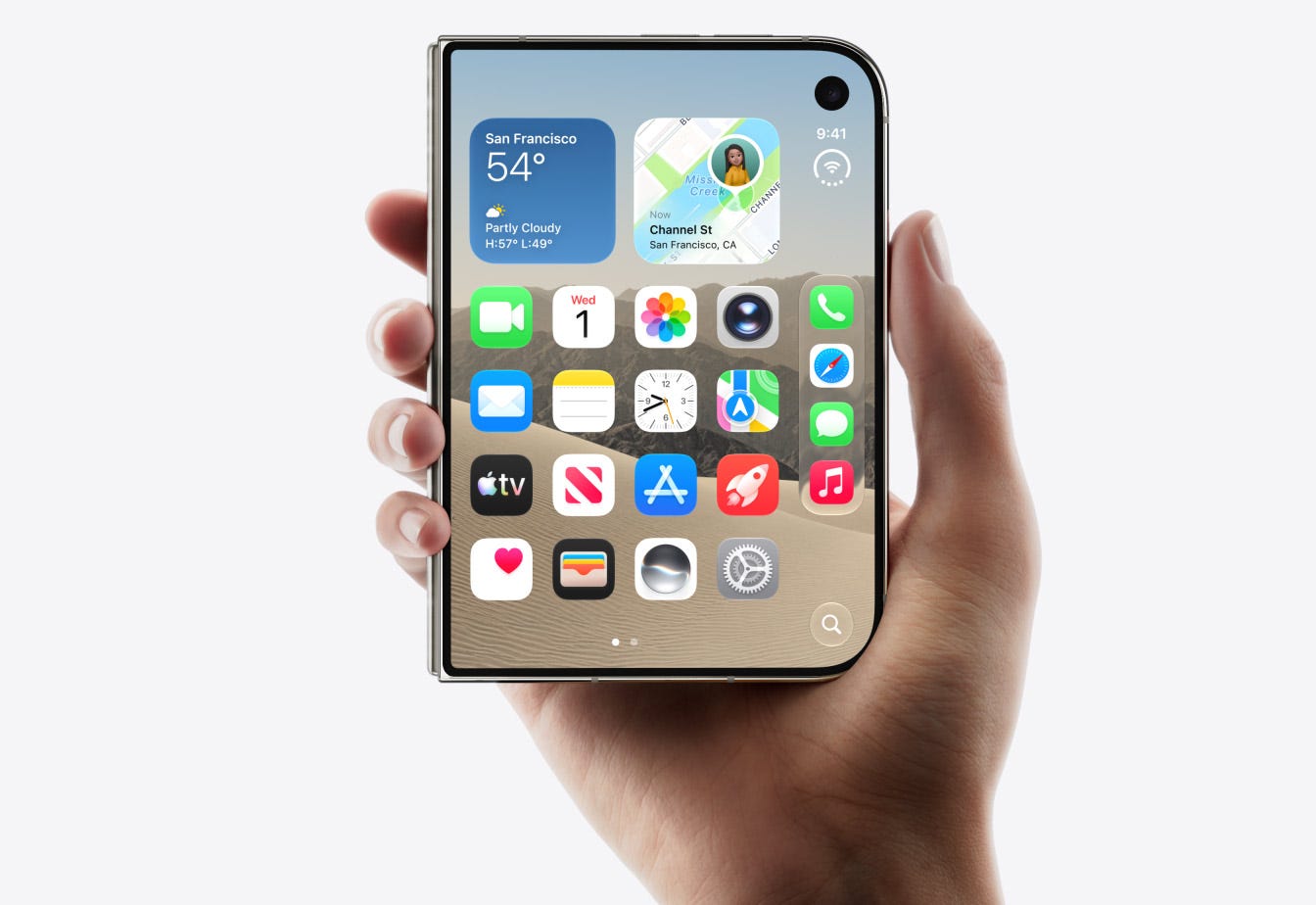
After years of watching rivals develop foldable smartphones, Apple has unveiled the iPhone Duo alongside the iPhone 18 Pro and Pro Max, marking one of the most significant changes to the iPhone since its 2007 debut.
Apple has finally entered the foldable smartphone race.
The company on Wednesday unveiled the iPhone Duo, its first foldable iPhone and arguably the most dramatic redesign of its flagship smartphone since the original device arrived nearly two decades ago.
Opening like a book, the iPhone Duo transforms from a conventional pocket-sized device into a 7.6-inch display designed to offer users considerably more screen space without requiring them to carry a tablet.
The new device was revealed at Apple’s headquarters in Cupertino, California, during a product event led by the company’s new chief executive, John Ternus.
Rather than portraying Apple as late to the foldable market, Ternus suggested the company had deliberately waited until it believed it could create a device that felt distinctly different from competing products.
“Others have created foldables that just feel like two phones awkwardly stuck together,” Ternus said during the livestreamed presentation.
Apple’s approach, he said, was to build a larger display that feels “as natural and intuitive as iPad.”
Ternus described the Duo as offering the biggest screen Apple has ever placed on an iPhone while remaining small enough to comfortably fit inside a pocket.
Two Screens, One iPhone
The iPhone Duo uses two displays.
An external screen allows the device to function while folded, while opening the phone reveals a much larger internal display.
Greg Joswiak, Apple’s senior vice president for worldwide marketing, said the unfolded 7.6-inch screen provides about 50% more display area than the iPhone Pro Max.
Apple’s demonstrations also showed the Duo operating while partially unfolded, potentially creating new ways of positioning and interacting with the device.
The phone is constructed from titanium and includes speakers positioned at both the top and bottom. Apple said the first models will be available in two finishes: Star White and Night Sky.
The unveiling came with a familiar piece of Apple history.
Ternus introduced the device as “one more thing,” reviving the expression famously associated with Apple co-founder Steve Jobs, who often used the phrase before revealing an unexpected product at the end of company presentations.
This time, that surprise represented something Apple has resisted for years: fundamentally changing the physical shape of the iPhone.
Apple Joins a Market Its Rivals Built
Foldable smartphones are hardly new.
Samsung has spent years developing the category and has been one of its most visible champions since entering the market in 2019. Other manufacturers have also experimented with devices that either unfold into tablet-sized screens or collapse into unusually compact phones.
The category remains relatively small compared with the broader smartphone industry. Foldable smartphone shipments reached an estimated 19.6 million units in 2025, still only a fraction of total global smartphone sales.
Competition is continuing to expand.
Chinese manufacturers Huawei and Xiaomi introduced new foldable devices earlier this week, priced at $2,980 and $3,725 respectively.
Apple is therefore entering an established market rather than inventing a new one.
But that strategy is hardly unfamiliar territory for the company.
Apple has repeatedly entered product categories after competitors and subsequently turned its versions into mainstream products. Wireless headphones existed before AirPods, just as smartwatches existed before the Apple Watch.
The question now is whether Apple can perform the same trick with foldable smartphones.
Can Apple Make Foldables Mainstream?
Despite years of development, foldable phones have yet to become a dominant part of the smartphone market.
One of their biggest selling points is also one of their biggest challenges.
A folding display allows manufacturers to offer considerably more screen space without dramatically increasing the size of the device in a user’s pocket. But the hinges and flexible displays required to make that possible have also raised questions about longevity and durability.
Enthusiasts have attempted to demonstrate how much punishment the technology can withstand, with videos online claiming to show certain foldable devices surviving as many as 200,000 folding cycles.
Still, consumer concerns remain: if a smartphone repeatedly bends in half, will it ultimately be more vulnerable than a conventional device?
Apple will now have to convince buyers that the Duo can deliver the advantages of a foldable display without introducing compromises large enough to outweigh them.
The technology itself has been developing for decades.
As far back as 2007—the same year the first iPhone was introduced—Polymer Vision demonstrated the Readius, an experimental foldable electronic reader featuring a flexible grayscale display. The company closed two years later, but the concept of screens capable of bending, rolling or folding continued to develop.
Nearly 20 years later, Apple is betting that the technology is finally ready for its biggest audience yet.
iPhone 18 Pro and Pro Max Also Arrive
The Duo may have dominated Apple’s presentation, but it wasn’t the company’s only new smartphone announcement.
Apple also introduced the iPhone 18 Pro and iPhone 18 Pro Max, bringing a series of upgrades to its established premium smartphone line.
Among the changes are improvements to battery performance and charging speeds. Apple said the devices can deliver more than 24 hours of battery life while charging faster than previous generations.
Camera improvements include enhanced aperture controls, while changes to thermal management are intended to help the devices better control heat during demanding tasks.
Apple is also expanding customization around Siri, allowing users greater control over the voice of its artificial intelligence assistant.
Another feature, called Apple Reference Image, is designed to help establish whether an image is authentic at a time when generative artificial intelligence is making digitally created and manipulated imagery increasingly difficult to distinguish from conventional photography.
That feature places Apple directly into one of technology’s emerging challenges: establishing trust in digital content as generative AI becomes more sophisticated.
A Major Test for Apple’s New Leadership
The iPhone Duo arrives at an important moment for both Apple and Ternus.
Apple remains one of the world’s most influential consumer technology companies, but the smartphone market has matured considerably since the extraordinary growth years that followed the original iPhone.
Ternus now inherits the challenge of maintaining consumer enthusiasm for a product line that has been central to Apple’s financial success.
Annual improvements to processors, cameras, displays and batteries can make smartphones better, but they do not necessarily provide consumers with compelling reasons to replace devices that already work well.
A completely different form factor could change that calculation.
For the first time in nearly two decades, buying a new iPhone could mean purchasing something that doesn’t simply look like a more refined version of the previous generation.


The iPhone Duo represents Apple’s bet that changing what an iPhone can physically become may be enough to start another upgrade cycle.
Samsung and other manufacturers have spent years proving that a smartphone screen can fold.
Apple’s challenge is different.
It must prove that millions of ordinary iPhone users actually want theirs to.


