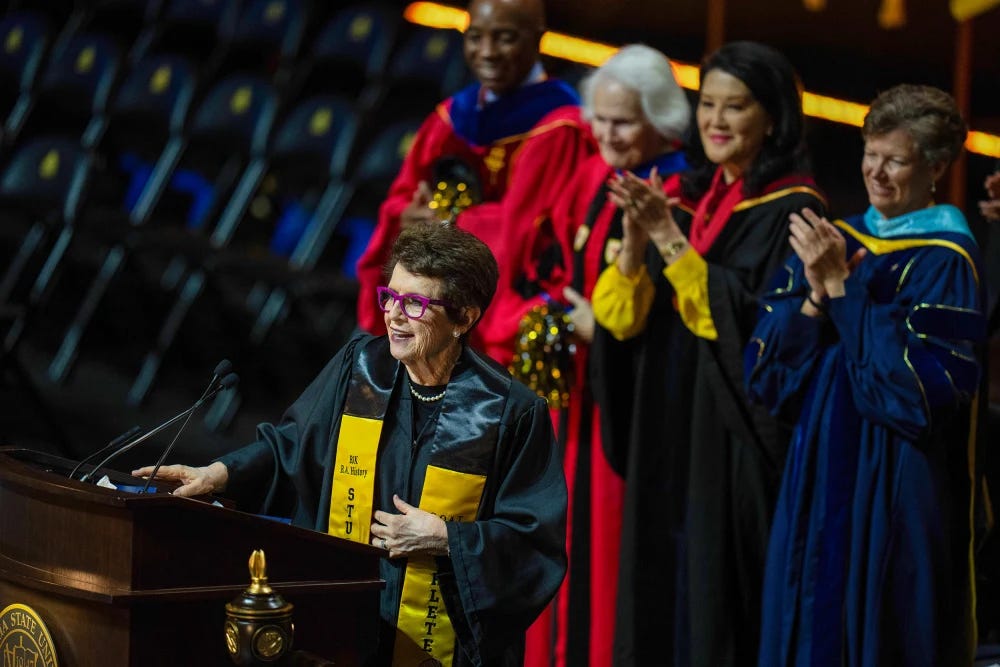
Billie Jean King, 82, earns a college degree 65 years after first taking classes
Billie Jean King, 82, finally closed a chapter she started more than six decades ago—earning a college degree she left unfinished while building one of the most influential careers in sports history.

The tennis legend and lifelong advocate for equality received her Bachelor of Arts in history from California State University, Los Angeles, on Monday, walking across the stage at the Shrine Auditorium alongside roughly 6,000 graduates in the Class of 2026.
She entered in unmistakable style—hot pink glasses, royal blue sneakers, and a presence that drew attention long before her name was called. When it was, she raised her right arm in celebration, not for a Wimbledon title this time, but for a milestone delayed 65 years.
“It’s never too late. Whatever age you are, whatever your abilities are, go for it if you want it,” she said afterward.
For Billie Jean King, the moment carried a weight that went beyond ceremony. Her black graduation gown was accented with a gold stole customized by a friend—one side embroidered with her initials and the phrase “G.O.A.T.” while the other featured a colorful tennis racket, a nod to the sport that defined her life.
She said the achievement meant more than she expected.
“It means a lot more to me than I thought,” she said. “I am so glad I did it. My hope is that one other person will go back to school.”
King first enrolled at Cal State LA in 1961, the same year she won her first Wimbledon title in women’s doubles. But the demands of a rising professional career quickly pulled her away from the classroom and toward the global tennis stage.
What followed was a career that reshaped the sport: 39 Grand Slam titles, a landmark victory in the 1973 “Battle of the Sexes” against Bobby Riggs, and a central role in building the foundation of modern women’s professional tennis. Alongside those achievements came decades of activism pushing for equal pay, expanded opportunities, and visibility for women in sports.
Still, the unfinished degree lingered in the background.
“I said, ‘Don’t ever say graduated, I haven’t earned it yet,’” she recalled. “I was thinking today, coming over here for the first time, actually, they can say I graduated now.”
On Monday, she finally said it herself.
The ceremony itself reflected the scale of the moment. Surrounded by thousands of graduates—many from first-generation college backgrounds—King acknowledged the shared significance of the occasion. Cal State LA’s student body is predominantly Hispanic and Latino, and like many of her fellow graduates, she is the first in her immediate family to complete a college degree.
She also reflected on how uneven access to education and opportunity once was, especially for women in athletics.
“Being a student-athlete didn’t mean I had a scholarship,” she told the audience. “Financial support wasn’t available to women in 1961, even though my friends Arthur Ashe and Stan Smith were both scholarship students on the men’s teams at UCLA and USC.”
The contrast between then and now was a recurring theme in her remarks. She pointed to the evolution of sports, education, and technology—remarking that today’s students learn in a far more virtual environment than she ever experienced.
“It’s so much more virtual,” she said. “Gosh, we had to be in class. I didn’t go all the time, but I loved talking to the professors and I loved learning.”
At one point during her speech, a crying baby from the balcony briefly interrupted her remarks. Without missing a beat, she responded with humor: “Is it that bad?” The audience laughed.
She ended her address with a familiar rallying cry that has defined much of her advocacy work: “¡Sí se puede!” The crowd responded with a roar of applause.


After the ceremony, King joined student athletes and the school mascot on stage, hitting autographed tennis balls into the audience—blending celebration with the sport that made her a global figure.
Her return to campus also carried symbolic weight. Cal State LA has honored her with a bronze statue outside its physical education building, recognizing both her athletic legacy and her impact on gender equality in sports.
Despite her decades of achievements, she admitted the absence of a degree had always stayed with her in a quiet way—less visible than trophies, but never entirely forgotten.
That chapter is now closed. And while she joked about the possibility of pursuing a master’s degree after seeing other athletes continue their education, she framed it less as a plan and more as a philosophy.
“I just think it’s wonderful to keep learning,” she said, referencing former NBA star Shaquille O’Neal, who recently earned a graduate degree.
For someone whose life has been defined by breaking barriers, the moment was less about finishing late and more about finishing deliberately—on her own terms, in her own time.


Brilliant.
Thank you for writing this! Truly a momentous occasion. Interesting timing for me. Billie Jean King crushing that braggart in a match happened on Sept 30, 1973, the first month of my first year at UVA. It was only the 3rd year since women were allowed, after winning a lawsuit, to attend this taxpayer funded state University. Circumstances were I was only able to attend 2 years but I have been contemplating returning to school again at 70… I will be doing more than considering now and start taking steps to see my options. Thank you for this shift of perspective and bringing back someone who was phenomenally influential to me as a young woman to have a powerful impact on me at 70. I appreciate you!
