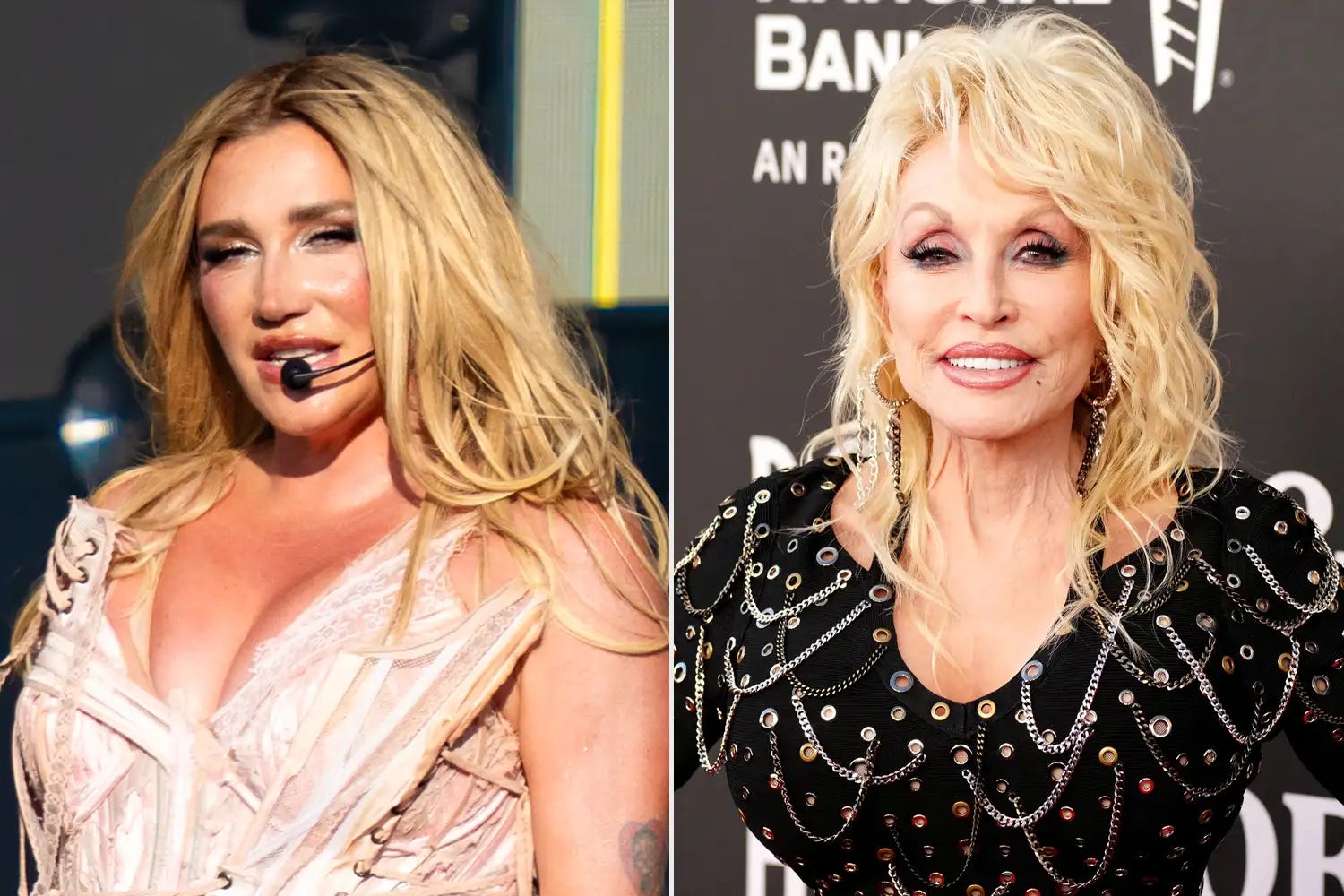
Kesha paid an emotional tribute to Dolly Parton during her concert at the Pavilion at Star Lake in Pittsburgh, performing a heartfelt rendition of Parton’s 1980 hit “Old Flames (Can’t Hold a Candle to You).”
The performance carried particular significance for Kesha because of her family’s connection to the song. “Old Flames (Can’t Hold a Candle to You)” was originally recorded and released by Joe Sun in 1978 before Parton recorded her own version and helped turn it into a country hit in 1980. One of the songwriters behind the track was Kesha’s mother, Pebe Sebert.
Before beginning the song, Kesha addressed the audience. She reflected on Parton’s legacy, describing the country music icon as someone whose influence would continue through the music, generosity, and love she shared with others.
“I just want to say thank you for bringing me so much joy today, because earlier today, I’m sure many of y’all know that we lost Ms. Dolly Parton,” Kesha told the audience. “We literally lost an angel.”
Kesha continued by explaining that although Parton may be gone, she believed the singer’s artistic and personal legacy would endure.
“But through her art and through her kindness and through her love, she will live forever,” she said.
The singer then turned to the remarkable story connecting Parton, her mother, and her own childhood.
Kesha explained that she comes from a family with a long history of songwriting and that, before she was born, her mother helped write the song that Parton would eventually make famous.
“For those of you who don’t know, I come from a long lineage of songwriters, and before I was born, my mom actually wrote a song for Dolly Parton,” Kesha explained.
The success of the song, she added, had a profound impact on her family’s life. According to Kesha, the money generated by the composition helped provide financial security for her family during her childhood.
“And that song bought us a house, like a roof,” she told the crowd. “That song put me through school.”
But Kesha’s relationship with “Old Flames” eventually became much more than a childhood story about one of her mother’s songwriting successes.
Decades later, Kesha recorded the song herself, and Parton joined her on the track for Kesha’s 2017 album Rainbow. For Kesha, having one of her childhood heroes sing alongside her came during an especially difficult chapter in her career and personal life.
Speaking to the Pittsburgh audience, Kesha recalled creating the album while facing frightening litigation and navigating a period when her experiences had become closely connected with the wider #MeToo movement.
“For those of you who don’t know, I was making that album in the middle of very scary litigation, and I was in the #MeToo movement,” Kesha said.
Parton’s decision to collaborate with her during that period meant far more to Kesha than simply securing a legendary guest vocalist.
“And having such a legendary woman do this song with me and stand beside me, it made me really feel like God was on my side,” she continued. “And that’s how it feels working with Dolly Parton.”
Kesha then dedicated the performance to Parton and the legacy she left behind.
“So in honor of her incredible legacy and her beautiful life, I’d like to sing the song that my mom wrote for her,” she told the crowd.
Kesha has previously spoken openly about the enormous influence Parton had on her long before the two women ever worked together.
In a 2022 interview with Rolling Stone, Kesha described Parton as a “guiding light” throughout her life, recalling that as a child she viewed the country superstar as almost larger than life.
“Dolly didn’t seem like a real human to me,” Kesha said at the time. “It was almost like when you talk about unicorns.”
She remembered Parton as someone who seemed almost mythical from the perspective of her younger self.
“I remember as a little kid, it was like she was this fable, like untouchable, unhuman, just badass,” Kesha said.
That childhood admiration took on an entirely different meaning when Parton eventually agreed to collaborate with her.
For Kesha, Parton’s willingness to record with her represented a turning point. The experience was so meaningful that Kesha said it influenced the standards she would later establish for her own music.
“It was a real corner turned in my mind once she said she would collaborate with me,” Kesha explained.
She said she subsequently created a personal rule for deciding what kind of music she wanted to release: she did not want to make something that she believed Parton herself would reject.
“I made a rule to not do any music — no matter how successful it could be, no matter how many people would love it — that Dolly Parton wouldn’t fuck with,” Kesha said.
For Kesha, that standard was not simply about trying to imitate Parton’s music. Instead, it reflected her admiration for Parton’s personality, humor, creativity and authenticity.
“I don’t ever want to put out any music that Dolly Parton wouldn’t enjoy or listen to, or find some humor in,” she said. “She’s so much of a guiding light, and she has no idea.”
The admiration between the two artists was not entirely one-sided.
Parton herself previously discussed “Old Flames (Can’t Hold a Candle to You)” and her decision to collaborate with Kesha on the song.
In 2017, Parton described the track as “one of my favorite songs that I ever did,” making Kesha’s decision to revive it particularly meaningful.
Parton also recalled being surprised when she first learned that Kesha wanted to record the song because it was not necessarily an obvious selection for the pop singer.
“I said, ‘Why did you choose to do that song? That’s an unusual choice for you,’” Parton recalled.
Kesha’s explanation immediately revealed why the track was so personal.
“She said, ‘Well, because my mother wrote it,’” Parton remembered.
That connection ultimately brought together three generations of musical history: Pebe Sebert as one of the song’s writers, Parton as the artist who transformed it into a major country hit, and Kesha as the daughter who eventually returned to the song and recorded it alongside one of the artists she had admired since childhood.
Years after their collaboration, “Old Flames (Can’t Hold a Candle to You)” continues to represent much more than another song in Kesha’s catalog.
It connects her mother’s songwriting career with Kesha’s childhood, her own journey as an artist and her longstanding admiration for Parton.
And during her Pittsburgh concert, Kesha brought that history back to the stage, using the song that once helped provide a home and education for her family to celebrate the woman she has repeatedly described as one of the guiding lights of her life.


