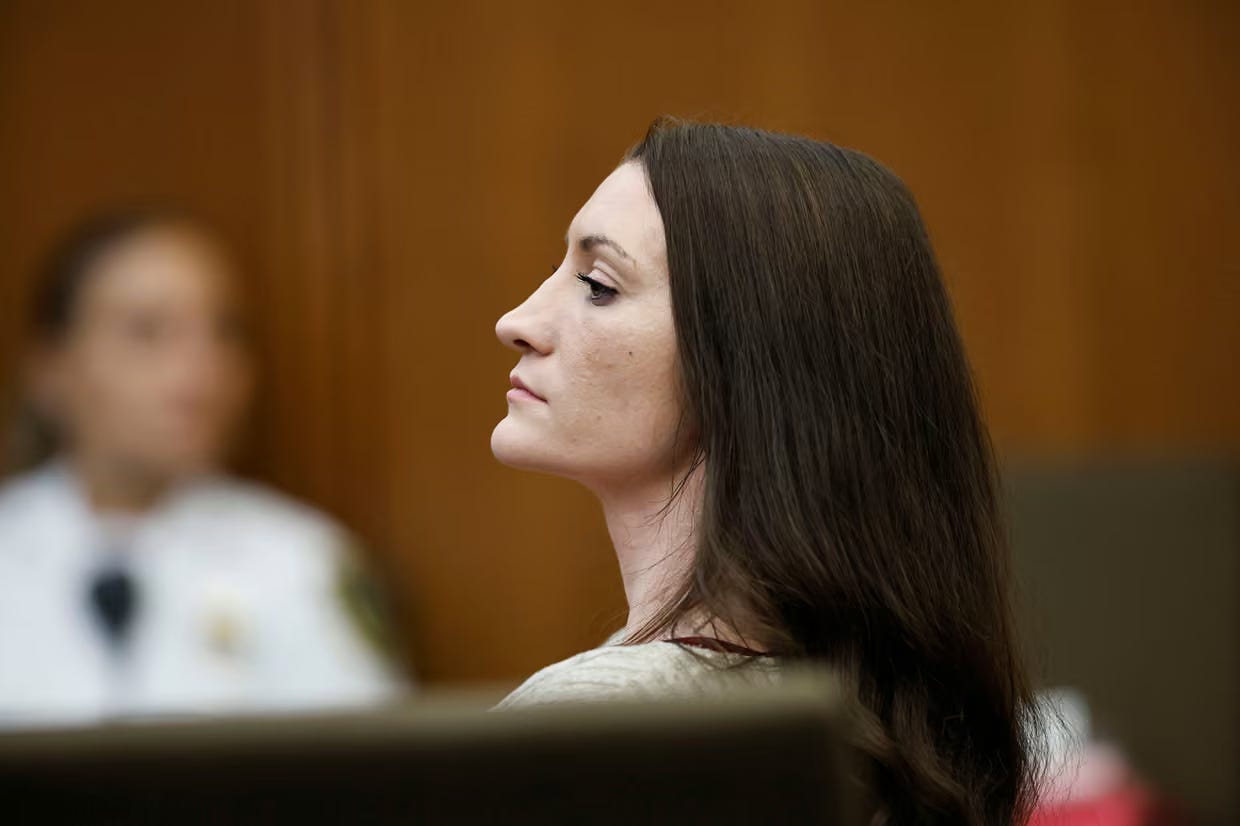
As jurors decide whether Lindsay Clancy was criminally responsible for killing her three children, the case has opened a painful national conversation about motherhood, mental illness, and what it really means to get help before a crisis becomes a tragedy.
Three children are dead.
A mother is accused of killing them.
And now a jury must answer a question that is both legally specific and emotionally devastating: Did Lindsay Clancy understand what she was doing when she strangled her children, or had severe mental illness taken away her ability to distinguish right from wrong or control her actions?
That question belongs to the jury.
But outside the courtroom, another question has become impossible to ignore:
What happens when a mother says she is struggling, seeks help, and continues to deteriorate?
The murder trial of 36-year-old former labor and delivery nurse Lindsay Clancy has become about much more than one Massachusetts family.
It has forced Americans to look at an uncomfortable side of motherhood — one rarely represented in baby announcements, maternity photographs or the cultural expectation that giving birth should automatically usher a woman into one of the happiest periods of her life.
Sometimes motherhood arrives alongside depression.
Sometimes anxiety.
Sometimes terrifying thoughts.
And in rare cases, psychosis.
None of that diminishes the horror of what happened to Clancy’s children: Cora, 5, Dawson, 3, and Callan, 8 months.
Their lives and deaths must remain at the center of this tragedy.
But understanding what happened to their mother before their deaths matters too.
She Was Seeking Help
The defense’s portrait of Lindsay Clancy is not of a woman who simply woke up one day and became violent.

Her attorney, Kevin Reddington, has argued that her mental health had been unraveling for months and that the medical care she received failed to stop that deterioration.
According to evidence and arguments presented during the trial, Clancy researched postpartum depression, contacted a suicide hotline, saw healthcare professionals, and voluntarily admitted herself for psychiatric treatment.
Her defense has also focused extensively on the medications she was prescribed.
Reddington’s central argument is that Clancy was not criminally responsible because she was suffering from severe mental disease when she killed her children.
During closing arguments, he returned again and again to the idea that this was a woman trying to obtain help while becoming progressively more unwell.
For many women following the case, that part of the story may be particularly disturbing.
Because we frequently tell women to ask for help.
We tell mothers:
Speak up.
Tell someone.
Call your doctor.
Go to therapy.
Seek treatment.
Don’t suffer alone.
Clancy apparently did many of those things.
And yet three children still ended up dead.
That does not automatically prove that the healthcare system caused their deaths.
Nor does seeking treatment establish that Clancy was legally insane when she killed her children.
But it does raise a question worth asking far beyond this courtroom:
Is telling women to “get help” enough if the help they receive fails to recognize how dangerous their condition has become?
The Prosecution Says That Is the Wrong Question
Prosecutor Jennifer Sprague has urged jurors not to allow the wider debate about women’s mental healthcare to determine their verdict.
The trial, she argued, is not a referendum on the healthcare system.
And legally, she has an important point.
Jurors are not being asked to determine whether postpartum healthcare in America is adequate.
They are being asked to determine Lindsay Clancy’s criminal responsibility.
The prosecution acknowledges that Clancy experienced mental health problems. But it disputes the defense’s contention that psychosis rendered her incapable of understanding or controlling her actions.
Instead, prosecutors have presented evidence they say demonstrates planning.
They allege that Clancy sent her husband, Patrick, out to collect takeout food and medication, leaving her alone with the children.


The state has also focused on evidence that she checked how long the trip would take.
To prosecutors, those actions were not meaningless details.
They were evidence of calculation.
Their argument is essentially this: Clancy needed time alone, knew approximately how much time she had and created a window in which she could kill the children without interruption.
The prosecution has also highlighted evidence that Clancy had not fully disclosed thoughts of harming her children to mental health professionals because she feared being separated from them.
Sprague argued that such thinking demonstrated an awareness that those thoughts were wrong.
That distinction could prove crucial.
Mental illness and criminal responsibility are not automatically opposites.
A person can be mentally ill and still be legally responsible for a crime.
That is precisely what prosecutors are asking jurors to conclude.
But Postpartum Psychosis Is Real
Whatever verdict the jury ultimately reaches, postpartum psychosis itself should not become collateral damage in the debate surrounding this case.
It is a real and serious psychiatric condition.
Research has estimated that postpartum psychosis occurs in approximately one to two cases for every 1,000 births.
The condition can involve hallucinations, delusions, severe confusion, disorganized thinking, paranoia and dramatic changes in behavior.
For the women who experience it, reality itself can become distorted.
That does not tell us whether Lindsay Clancy was psychotic at the precise moment her children died.
Experts in this trial have disagreed about her mental condition.
That question belongs to the evidence and ultimately the jury.
But the rarity of postpartum psychosis should never be confused with insignificance.
Rare conditions still destroy lives.
And when the illness involves a person’s ability to understand reality, early recognition can become extraordinarily important.
Motherhood Does Not Immunize Women Against Mental Illness
There is another uncomfortable assumption hiding beneath cases like this one.
Society often treats motherhood as though it should overpower everything else.
A mother should love enough.
Endure enough.
Sacrifice enough.
Cope enough.
Stay strong enough.
And when she cannot, people sometimes interpret her struggle as a failure of character before considering the possibility of illness.
Women can adore their children and still become severely mentally ill.
They can be responsible professionals and still experience psychiatric crises.
They can understand medicine and still become patients themselves.
Clancy’s background makes that contradiction especially striking.
She wasn’t unfamiliar with healthcare.
She was a labor and delivery nurse.
She had spent her professional life around mothers, babies and childbirth.
Yet professional knowledge does not make someone immune from disease.
A cardiologist can have a heart attack.
An oncologist can develop cancer.
And a nurse can experience psychiatric illness.
Three Children Cannot Become Footnotes
There is also a danger in discussing the Clancy case primarily through the lens of maternal mental health.
Cora, Dawson and Callan cannot become supporting characters in a national conversation about their mother.


They were children.
They had lives.
They had a father.
They had relatives who loved them.
And whatever was happening inside Lindsay Clancy’s mind, they were the ones who paid the ultimate price.
Any meaningful conversation about postpartum mental healthcare must therefore hold two truths simultaneously.
We can demand better protection for mothers experiencing severe psychiatric illness.
And we can demand protection for their children.
Those goals are not in conflict.
In fact, they are inseparable.
Protecting a mother in psychiatric crisis can also mean protecting the baby sleeping beside her, the toddler running through her home and the older child depending upon her.
Maternal mental healthcare is therefore not merely women’s healthcare.
It can be family healthcare.
And, in extreme circumstances, it can become a matter of life and death.
What Does “Getting Help” Actually Mean?
Perhaps this is the question the Clancy case should leave behind.
We have become comfortable telling struggling people to seek help.
But what happens after they do?
Who recognizes when ordinary postpartum anxiety has become something more dangerous?
Who connects the dots when a woman visits multiple providers?
Who listens when she says something feels terribly wrong?
Who evaluates the medications?
Who speaks with the family?
Who asks about intrusive thoughts?
Who determines whether she is safe to be alone?
Who determines whether her children are safe?
And when warning signs appear across several appointments, professionals and institutions, who sees the entire picture?
Those questions cannot be answered by slogans.
“Ask for help” is an important message.
But a functioning mental healthcare system must also be prepared to answer when someone does.
The Jury Has a Different Job
None of these larger questions should determine Lindsay Clancy’s guilt.
Jurors have been instructed to evaluate the evidence and decide whether the state has proved criminal responsibility under Massachusetts law.
The defense says severe mental disease robbed Clancy of that responsibility.
The prosecution says her actions demonstrate the opposite: awareness, calculation and choice.
The jury must decide between those competing accounts.
The rest of us have another responsibility.
We must resist turning the case into something simplistic.
It is possible to grieve three children without dismissing maternal mental illness.
It is possible to advocate for postpartum mental healthcare without declaring Clancy innocent.
It is possible to believe women deserve better psychiatric care while also asking difficult questions about personal responsibility.
And it is possible to recognize that no verdict can make this story whole again.
If Clancy is convicted, three children will still be dead.
If she is found not criminally responsible, three children will still be dead.
No courtroom decision can restore Cora, Dawson and Callan to their father and family.
But perhaps the attention surrounding their deaths can force healthcare providers, policymakers, families and communities to take maternal mental illness more seriously.
Because behind the smiling photographs of new motherhood are women whose experiences can be far more complicated than society wants to acknowledge.
Some are exhausted.
Some are depressed.
Some are frightened by thoughts they do not understand.
And a very small number may lose their connection with reality altogether.
We should not wait until one of those women enters a courtroom before asking whether anyone truly saw her deteriorating.
The Lindsay Clancy jury will decide whether one mother is criminally responsible for an unimaginable act.
America must decide what it is willing to learn from everything that happened before it.


An important article. Thank you.
