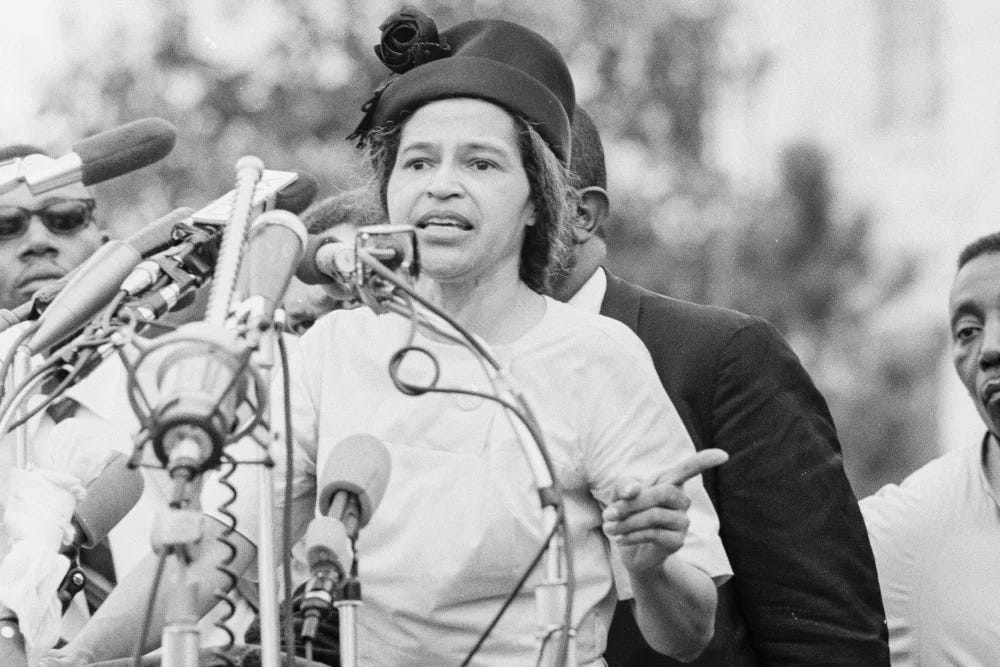
Newly Unseen Photos Reveal Rosa Parks’ Quiet Strength During the 1965 Selma-to-Montgomery March
Never-before-seen images of Rosa Parks at the 1965 Selma-to-Montgomery march arrive amid renewed assaults on voting rights — a stark reminder that democracy must be defended now.

MONTGOMERY (TWP). Nearly seventy years after Rosa Parks’ quiet act of courage on a Montgomery bus cemented her place in American history, long-hidden images of her activism have been made public for the first time. These photos, taken by the late Civil Rights photographer Matt Herron, show Parks participating in the historic five-day, 54-mile march from Selma to Alabama’s capital — an event widely credited with accelerating passage of the landmark Voting Rights Act of 1965.
While Parks is most often remembered for refusing to surrender her seat on Dec. 1, 1955 — sparking the 381-day Montgomery Bus Boycott — the newly released images highlight the breadth of her dedication to the movement. On Friday, original boycott participants and descendants of the organizers gathered to commemorate the seventh decade since that transformative campaign ended segregated public transportation.

Donna Beisel, director of the Rosa Parks Museum, said the never-before-seen photos, delivered to the museum Thursday, remind the world that Parks’ activism did not begin or end with that single courageous moment.
“This shows who Ms. Parks truly was — both the person and the lifelong activist,” Beisel said.
Many known photographs place Parks among the other towering figures of the Civil Rights movement present on the march. Herron himself captured several of them. But these newly public images were never printed or featured in any exhibit or book throughout Herron’s career.
Herron relocated to Jackson, Mississippi, in 1963 with his wife and two children after Civil Rights leader Medgar Evers was assassinated. For the next two years, he chronicled many of the defining people, confrontations, and moments of the era. Yet, more often than not, Herron focused his lens on ordinary individuals whose collective courage empowered movement leaders to push for change.
His wife, 88-year-old Jeannine Herron, said the images made public this week were uncovered in a contact sheet stored in a Stanford University library.
The photos likely weren’t chosen for printing at the time because they appeared slightly blurred or featured individuals who weren’t widely recognized — including Parks herself, seen sitting among marchers and looking away from the camera.

Now Jeannine Herron is collaborating with historians and surviving activists in Alabama to return these images to the communities they came from.
“It matters deeply to bring this history back home so people understand what their families lived through and contributed to,” she said.
A joyful reunion decades in the making
One of Herron’s most frequently photographed subjects during the Selma-to-Montgomery march was Doris Wilson, a 20-year-old from Marion, Alabama. Even decades later, he spoke of wanting to find her again.
“I wish I knew where she was today,” he said during a 2014 discussion among Civil Rights veterans and journalists who had witnessed that turbulent era in the Deep South.

Herron passed away in 2020, never getting his reunion. But on Thursday, Wilson — now 80 — gathered with fellow residents of Marion in the auditorium of Lincoln Normal School, a college founded after the Civil War by nine formerly enslaved Black Americans. There, locals studied Herron’s black-and-white photographs, recognizing faces, landscapes and memories.
Wilson had seen some of the images before. Others — including several in which she was the subject — she had never laid eyes on until now.
One photo shows her being treated at a medical tent along the march route, her feet covered in painful blisters from walking more than ten miles a day.
The doctor tending to her, June Finer, flew in from New York to reunite with Wilson for the first time since gently caring for her injuries nearly sixty years earlier.
“Are you the one who rubbed my feet?” Wilson asked, laughing as the two embraced. Finer, now 90, said she had no idea anyone was taking photos at the time — her only concern was keeping marchers safe.

Later, Wilson reflected on the emotional moment.
“I’ve wanted to see her for so long,” she said.
Her eldest son, Robert E. Wilson, who attended the event, said he had never seen the photos of his mother before. As a young child, he didn’t grasp the extent of what she endured.
“I’m stunned,” said the 62-year-old Marion native. “She told us she marched, but I never realized how strong she really was.”
A search years in the making
Cheryl Gardner Davis remembers fragments of the night in 1965 when her family welcomed weary marchers on the third night of the journey to Montgomery. She recalls strangers pitching tents across her family’s farm in rural Lowndes County, Alabama. She was only four, but she remembers her mother and older sister mopping mud from the hallway floors after marchers came inside to use the family’s landline.
As an adult, Davis came to understand the sacrifice involved: her mother’s teaching job was threatened, their electricity was cut off, and a neighbor threatened them with a rifle. For years, she searched online and in libraries for any photographic proof — even a shot of her family’s land during that historic night.
Among the hundreds of Herron’s photos that returned to Alabama this week were images of the campsite at Davis’ childhood home. She had never seen them before.
To Davis, the discovery is invaluable — a way to honor people whose roles in that monumental moment are too often forgotten.
“It’s a kind of validation,” she said. “It really happened. People were there. And now we can finally see it.”


This documentation work is absolutely crucial. What you've captured here is how Herron's choice to photograph ordinary marchers, not just movement leaders, preserved the truth that sustained resistance comes from regular people putting their bodies on the line. The reunnion between Doris Wilson and Dr. Finer feels almost unbearably moving, but its also evidence of how much we lose when we reduce movements to a few famous names intead of understanding them as collective acts of courage spread across thousands of participants.
