‘She is going to pay a very big price’: Trump escalates warning toward Delcy Rodríguez, Venezuela’s interim leader
In a wide-ranging interview with The Atlantic, President Donald Trump argued that rebuilding Venezuela and forcing political change would be an improvement over the country’s current leadership.

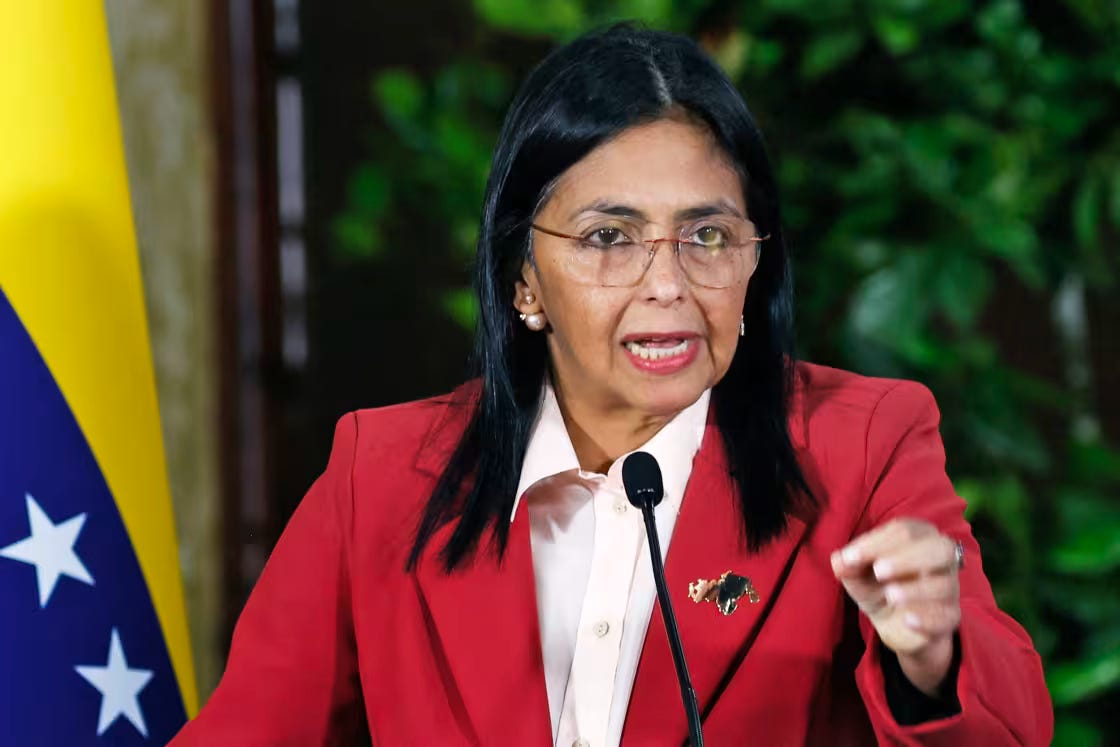
WASHINGTON — Donald Trump delivered a sharp and personal warning to Venezuela’s interim leader Delcy Rodríguez, telling The Atlantic that failure to comply with U.S. demands would come at an enormous cost.
“If she doesn’t do what’s right, she’s going to pay a very big price — probably even bigger than Maduro,” Trump said.
Rodríguez served as vice president under Nicolás Maduro. After U.S. forces captured Maduro and transported him to the United States, Venezuela’s supreme court declared Rodríguez the acting president.
Trump’s comments represent a notable shift from his tone just one day earlier, when he described Rodríguez’s discussions with Secretary of State Marco Rubio as cordial and cooperative.
“She had a long conversation with Marco, and she said, ‘We’ll do whatever you need,’” Trump told reporters Saturday. “I thought she was very gracious. But she really doesn’t have a choice. We’re going to do this the right way.”
That cooperative framing quickly unraveled. Later Saturday, Rodríguez publicly rejected Trump’s characterization, insisting Maduro remained Venezuela’s legitimate leader and demanding his immediate release.
Speaking to reporters aboard Air Force One on Sunday night, Trump said the U.S. required unrestricted cooperation from Rodríguez.
“We need total access,” he said. “We need access to the oil and to other things in their country that allow us to rebuild it.”
Rubio reinforced the administration’s position during an interview on ABC News’ This Week, arguing that Venezuela’s current leadership lacks democratic legitimacy.
“We do not believe that the regime in place is legitimate through an election,” Rubio said.
He added that legitimacy could only emerge through a transition period followed by genuine elections — something he said Venezuela has not experienced.
Later, on NBC News’ Meet the Press, Rubio dismissed any near-term discussions about elections as premature.
Trump also left open the possibility of further military action. During a Saturday press briefing, he warned that the U.S. was prepared to escalate its intervention.
“We are ready to stage a second — and much larger — attack if necessary,” Trump said.
He framed U.S. involvement as a reconstruction effort, describing Venezuela’s infrastructure as beyond repair.
“We’re rebuilding,” Trump said. “We have to rebuild their entire infrastructure. It’s completely rotted.”
Rodríguez responded in a written statement issued in Spanish, striking a dramatically different tone. She said Venezuela had extended an offer to the United States to cooperate within internationally recognized legal boundaries.
“President Donald Trump: Our people and our region deserve peace and dialogue, not war,” Rodríguez wrote. “That has always been President Nicolás Maduro’s position, and it is the position of Venezuela today.”
She added that her vision for the country remained rooted in unity and development.
“That is the Venezuela I believe in and have dedicated my life to,” Rodríguez wrote. “My dream is for Venezuela to become a great power where all Venezuelans of good will can come together.”
In his interview with The Atlantic, conducted by phone Sunday morning, Trump returned to his argument that any form of U.S.-driven restructuring would be preferable to Venezuela’s current political reality.
“Rebuilding there and regime change — whatever you want to call it — is better than what they have now,” Trump said. “It really can’t get any worse.”
Trump also used the interview to revisit another controversial ambition: expanding U.S. control over Greenland, a territory governed by Denmark, a NATO ally.
“We absolutely need Greenland,” Trump told The Atlantic reporter Michael Scherer. “We need it for defense.”
Shortly after the U.S. military operation in Venezuela, Katie Miller — a conservative podcast host and wife of Trump adviser Stephen Miller — fueled speculation about Greenland with a cryptic post on X.
“SOON,” she wrote, alongside an image of an American flag superimposed over a map of Greenland.
When pressed by reporters Sunday night, Trump declined to go into detail but reiterated his national security argument.
“It’s incredibly strategic,” Trump said. “Right now, Greenland is surrounded by Russian and Chinese ships all over the place. Denmark isn’t capable of handling it.”
He went further, claiming U.S. control would benefit not only Washington but Europe as well.
“We need Greenland for national security,” Trump said. “And the European Union needs us to have it — they know that.”
Denmark’s ambassador to the United States, Jesper Møller Sørensen, pushed back against the rhetoric, responding directly to Miller’s post.
“Just a friendly reminder about the relationship between the United States and the Kingdom of Denmark,” Sørensen wrote. “We are close allies and should continue to work together as such.”
He added pointedly, “And yes, we expect full respect for the territorial integrity of the Kingdom of Denmark.”
Nearly a year before taking office, Trump had already declined to rule out the use of force to secure control over Greenland or Panama.
“No, I can’t assure you on either of those,” Trump said at the time. “But I can say this: We need them for economic security.”


