


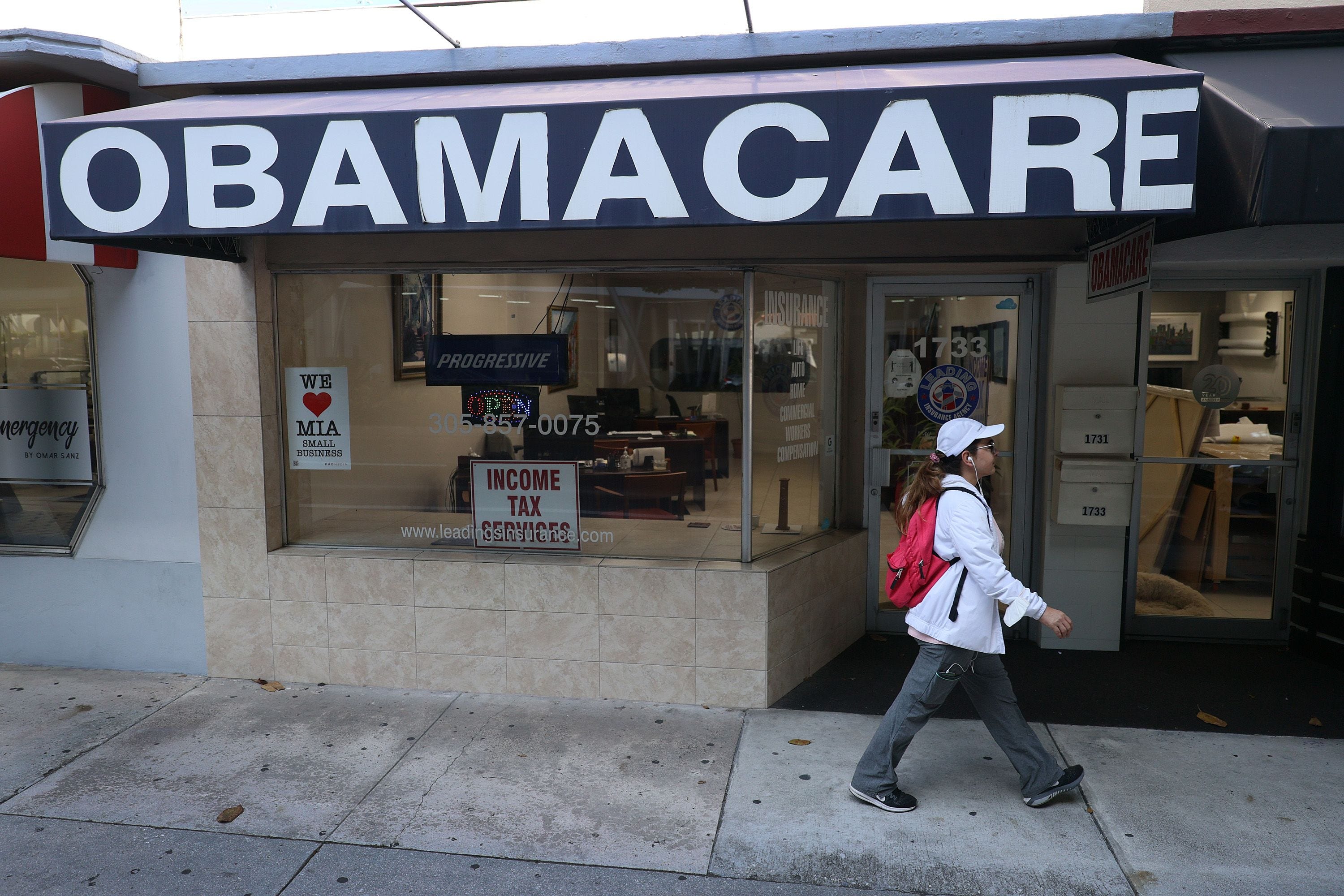
Even where leaders are willing, state governments cannot fully absorb the shock of rising insurance premiums.
With Congress walking away from Washington without extending enhanced Obamacare subsidies, states across the country are racing to blunt the fallout for millions of Americans facing sharp increases in health insurance costs.
At least a dozen states are now pursuing measures to cushion residents from the loss of federal aid that helped keep coverage affordable for tens of millions of people. Those efforts — unfolding in places like California, Colorado, Maryland, and New Mexico — come with a sobering reality: nearly every state admits it can only help some of those affected, not all.
“We can shoulder this burden temporarily,” said Javier Martínez, speaker of the New Mexico House, whose state is so far the only one to fully replace the expired subsidies. “But ultimately, Congress has to do its job. No state budget can permanently compensate for every gap the Trump administration leaves behind.”
The rapid response from predominantly Democratic-led states highlights a growing sense of alarm — not just about health care access, but about the broader economic and political consequences of the subsidies’ expiration. Without them, millions of Americans may find themselves priced out of coverage altogether, placing additional strain on already overstretched hospitals and state safety-net programs, and reversing years of progress in expanding access to care.
Still, the national response has been anything but uniform. Some states are moving quickly, others cautiously, and many not at all. Georgia and Washington state, for example, are unlikely to step in — though the reasons differ sharply. Meanwhile, states such as Connecticut and New Mexico planned ahead, allocating funds earlier this year in anticipation of Congress failing to act, and may revisit the issue when lawmakers return for new sessions.
California, which anticipated the lapse well in advance, was among the first to roll out a contingency plan. The state has earmarked nearly $200 million to replace federal subsidies for about 300,000 of its lowest-income residents. Even so, that assistance will not reach everyone. Roughly 2 million Californians rely on the state’s Obamacare exchange, and many will still see premiums spike.
Covered California, the state’s exchange marketplace, estimates that up to 400,000 people could drop coverage entirely as costs rise. In Maryland, where fewer residents are affected, the state is taking a more targeted approach: boosting aid substantially for the poorest enrollees while offering more limited relief to people at higher income levels.
In politically competitive states such as Maine, some lawmakers worry that stepping in too aggressively could ease pressure on Congress to deliver a federal fix. Still, many argue that concern should not stop states from acting now to protect residents.
The partisan divide is unmistakable. Blue states are far more likely than red ones to intervene in the Obamacare market. Yet even in Republican-led states, public pressure is mounting — and in some cases, prompting quiet action behind the scenes.
Documents obtained by local media through Freedom of Information Act requests show that Arkansas has joined deeply conservative Texas and Wyoming in adopting a strategy known as “premium alignment.” The approach rearranges costs within insurance markets to stretch remaining federal subsidies as far as possible and reduce out-of-pocket expenses for consumers, even without new state funding.
Despite these pockets of activity, most states have yet to act — including conservative states that oppose the Affordable Care Act outright and progressive states that support it but face fiscal or political hurdles.
Minnesota is one of several states expected to revisit the issue when legislatures reconvene in January. There, replacing the subsidies has drawn resistance from both parties. State Sen. Matt Klein, a Democrat running for the congressional seat vacated by Rep. Angie Craig, said some members of his own party view state-funded subsidies as a windfall for private insurance companies.
But Klein believes political reality may soon override ideological hesitation.
“Once people start calling and saying, ‘I can’t afford my health care anymore,’ that pressure becomes impossible to ignore,” he said. “That’s when lawmakers begin to realize we have to act.”
In many states, the biggest obstacle is money.
Washington state House Majority Leader Joe Fitzgibbon pointed to a looming budget shortfall as the primary reason his state cannot replace the lost federal subsidies. Minnesota faces a similar constraint, Klein noted, saying the state simply lacks surplus funds at this point in its fiscal cycle.
Elsewhere, the barriers are less about dollars and more about politics.
Georgia, for instance, has billions in surplus revenue, but Republican leaders have refused to use it to offset the loss of federal aid. Democratic state Rep. Sam Park has been urging lawmakers to dedicate some of that surplus to preserving coverage — a move he estimates would cost roughly $900 million annually.
For states like Georgia that never expanded Medicaid, Park warned, the stakes are especially high. Hundreds of thousands of residents could be forced out of the individual insurance market with no alternative coverage options.
Republican leaders have remained unmoved.
“We’re not going to clean up any mess created by Washington,” said state Sen. Ben Watson, who chairs Georgia’s Senate Health and Human Services Committee. “It’s not our responsibility to compensate for congressional compromises or failures.”
New Mexico’s decision to fully replace the subsidies is an outlier, but it was not alone in planning ahead. Colorado passed legislation during a special session earlier this year that significantly limited projected premium increases for 2026 — and lawmakers are expected to push to extend those protections through 2027.
Colorado state Sen. Kyle Brown, a member of the joint budget committee, said keeping people enrolled in private insurance plans is essential to preserving the state’s fragile rural health care infrastructure. Commercial Obamacare plans reimburse providers at higher rates than Medicaid, making them a financial lifeline for struggling hospitals.
“The biggest premium hikes are expected in rural communities,” Brown said. If residents drop coverage, he warned, hospitals will see more uninsured patients relying on emergency care — a scenario that could push some facilities to the brink of closure. “Keeping people insured isn’t just about coverage,” he said. “It’s about keeping hospitals alive.”
Other states remain undecided, weighing both fiscal risks and political consequences. In Maine, House Speaker Ryan Fecteau acknowledged concerns that state-level solutions could reduce the urgency for Congress to act when it returns in January.
“There’s a part of me that wonders whether this is becoming a kind of experiment,” he said, “where states are expected to fill the gaps left by the federal government.”
Park, however, rejected that logic. Even if congressional inaction continues, he argued, states cannot afford to stand by.
“This is a life-and-death issue,” Park said. “People’s lives are on the line. I’m tired of hearing politicians point fingers at other parties or other levels of government. We all have a responsibility to do what we can, with the resources we have.”