
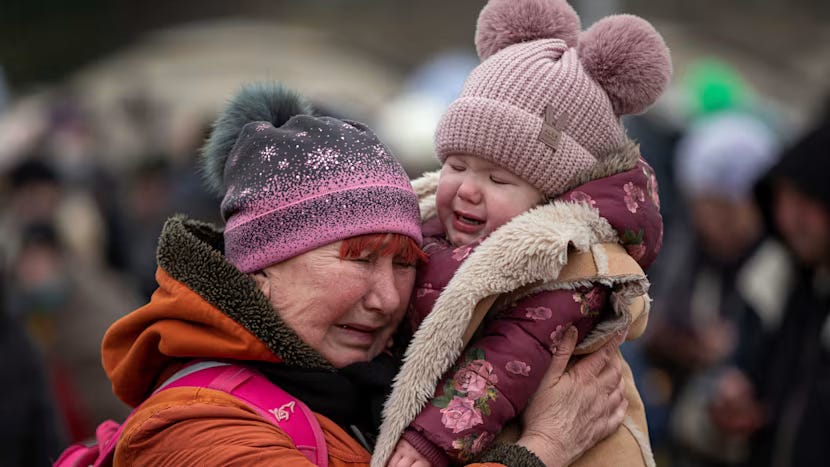
The Unspoken Cost of War: How Women and Children Pay for the Conflicts of Powerful Men.
Across modern conflicts, the wars waged by so-called powerful men continue to leave women and children carrying the heaviest burden—through displacement, violence, hunger, and death.
War is often narrated through the voices of generals and presidents. The language of conflict is replete with terms such as:
Strategy,
Deterrence,
National security,
And victory.
Leaders appear before cameras promising strength and resolve while military analysts discuss targets, troop movements, geopolitical consequences, and oil embezzlement from weaker countries.
But beyond the speeches and press briefings lies a harsher reality—one rarely centered in the halls of power.
In modern warfare, women and children are paying the highest price for conflicts overwhelmingly initiated and escalated by male unhinged political dementia.
From escalating tensions between the United States, Israel, and Iran to the grinding war between Russia and Ukraine, civilians—especially women and children—are bearing the consequences of decisions made far from the neighborhoods and homes now shattered by violence.
The cost of war is not merely measured in military casualties or destroyed equipment. It is measured in families torn apart, schools reduced to rubble, and children forced to grow up under the shadow of bombs.
And the pattern repeats with disturbing consistency.
A Dangerous Escalation in the Middle East
The latest flashpoint involves the intensifying confrontation between Israel and Iran, with the United States playing an increasingly direct role.
Israeli strikes on Iranian targets, coupled with American support and coordination, have raised fears of a broader regional conflict. Officials in both Washington and Tel Aviv have framed these actions as necessary responses to Iran’s military capabilities and influence across the Middle East.
Israeli Prime Minister Benjamin Netanyahu has repeatedly defended aggressive military action against Iranian assets, arguing that Israel must prevent Tehran from expanding its strategic reach.
Meanwhile, U.S. President Donald Trump has embraced a hard-line posture toward Iran, frequently emphasizing overwhelming force as the foundation of American foreign policy.
Yet when bombs fall in densely populated regions, the consequences rarely remain confined to military targets.
Airstrikes in urban areas inevitably ripple outward—damaging homes, hospitals, and schools. Civilians become collateral damage in conflicts framed as strategic necessities.
For families living near targeted infrastructure, war does not feel precise.
It feels random.
Parents scramble to gather children and flee as sirens sound. Hospitals fill with the injured. Communities that once functioned normally suddenly become frontlines.
History suggests that once large-scale military confrontations begin, civilians often endure the longest-lasting consequences.
The Ukraine War’s Civilian Toll


Thousands of miles away, another conflict continues to devastate families.
The war launched by Russian President Vladimir Putin against Ukraine in 2022 has become one of the deadliest conflicts in Europe since World War II.
While battlefield losses dominate headlines, the civilian toll has been staggering.
Entire Ukrainian cities have endured relentless missile and drone attacks. Residential buildings have been struck. Energy infrastructure has been repeatedly targeted, leaving millions without heat or electricity during harsh winters.
The result has been a humanitarian crisis affecting millions of civilians.
Children have no choice but to attend school online or in underground shelters. Families have been forced to flee their homes with little more than what they can carry. Many mothers have become the sole providers for their households as fathers remain on the frontlines.
For Ukrainian women, the war has meant navigating displacement, economic hardship, and the psychological trauma inflicted on their children.
Across Europe, refugee centers are filled with mothers attempting to rebuild stability for their families while their country remains under attack.
The statistics tell a devastating story.
Thousands of civilians have been killed since the invasion began. Tens of thousands have been injured. Millions have been displaced both internally and across borders.
Yet behind every number lies a human story—a child who will never return to school, a mother who lost a son, a family forced to start over in a foreign country.
War’s Most Vulnerable Victims

Modern warfare rarely spares civilians.
According to international humanitarian organizations, the majority of people affected by armed conflict today are not soldiers but civilians. Women and children represent a large portion of those displaced, injured, or killed.
The reasons are structural.
Wars increasingly take place in cities rather than remote battlefields. Military targets are often embedded within urban environments, meaning attacks inevitably spill into residential areas.
Infrastructure destruction compounds the suffering. When electricity systems, water networks, and hospitals are damaged, daily life collapses.
Women frequently become the primary caretakers responsible for protecting families in these environments.


They must locate food, secure shelter, and care for injured relatives while navigating environments filled with danger.
Children, meanwhile, experience the war differently but no less profoundly.
Psychologists studying war-affected populations consistently report long-term trauma among children exposed to conflict. Many grow up with disrupted education, chronic anxiety, and memories of violence that shape their lives for decades.
War does not simply kill civilians.
It reshapes childhood itself.
Power, Politics, and the Machinery of War
Why does this cycle continue?
Part of the answer lies in how global power is structured.
Political leadership around the world remains overwhelmingly male, particularly within defense and security institutions. Military decisions are often framed through a lens of dominance, retaliation, and strength.
Within that framework, escalation can become politically advantageous.
Leaders facing domestic pressure may use military action to demonstrate resolve. Others frame aggressive postures as necessary to maintain credibility or deterrence.
For leaders like Trump and Netanyahu, projecting toughness has been central to their political identity.
Their rhetoric frequently emphasizes strength, decisive action, and military superiority.
But the political benefits of appearing strong rarely translate into safety for civilians.
Instead, they often produce prolonged conflicts that devastate communities far removed from political decision-making.
The same dynamic has played out in Russia’s war against Ukraine, where political ambitions and territorial objectives have fueled a conflict that continues to claim civilian lives.
When wars become intertwined with political survival, the incentives for restraint disappear.
And civilians pay the price.
The Human Face of Conflict
It is easy for war to become abstract when viewed through policy debates or military briefings.
But its consequences are painfully concrete.
A mother searching through rubble for her child.
A boy who has spent half his life in bomb shelters.
A teenage girl forced to abandon school and flee across a border to safety.
These stories rarely dominate geopolitical analysis, yet they define the lived reality of modern conflict.
The wars unfolding today—from Eastern Europe to the Middle East—are not simply contests between governments.
They are humanitarian crises affecting millions of ordinary people.
And the burden falls disproportionately on those with the least power to influence political decisions.
Rethinking Global Leadership
The persistence of these patterns raises a critical question: what would a different approach to leadership look like?
Many analysts argue that global security policy has long been dominated by militarized thinking.
Diplomatic solutions are often sidelined until violence has already escalated. Negotiations begin only after enormous human suffering has occurred.
Yet research into peace processes suggests that more inclusive approaches—particularly those involving women in negotiations—often produce more durable outcomes.
Despite this evidence, women remain dramatically underrepresented in international security decision-making.
This imbalance reflects a broader problem: the voices most affected by war are rarely included in the conversations that lead to it.
If women and children continue to bear the greatest burden of armed conflict, excluding women from political power only deepens the problem.
A more stable global order may depend on expanding who gets to shape decisions about war and peace.
The Price the World Continues to Pay


The wars unfolding today are reminders that modern warfare has changed—but its human cost remains devastating.
Missiles may be more precise. Intelligence may be more advanced. Military technology may be more sophisticated than ever before.
But civilians are still dying.


Children are still growing up amid violence.
Families are still being forced to abandon their homes.
From Ukraine’s shattered cities to the rising tensions between Israel and Iran, the consequences of political decisions are written in human lives.
And those lives are overwhelmingly the lives of civilians.
As long as global politics continues to reward male leaders who escalate conflicts rather than resolve them, the pattern will persist.
Wars will be declared in the name of security.


