
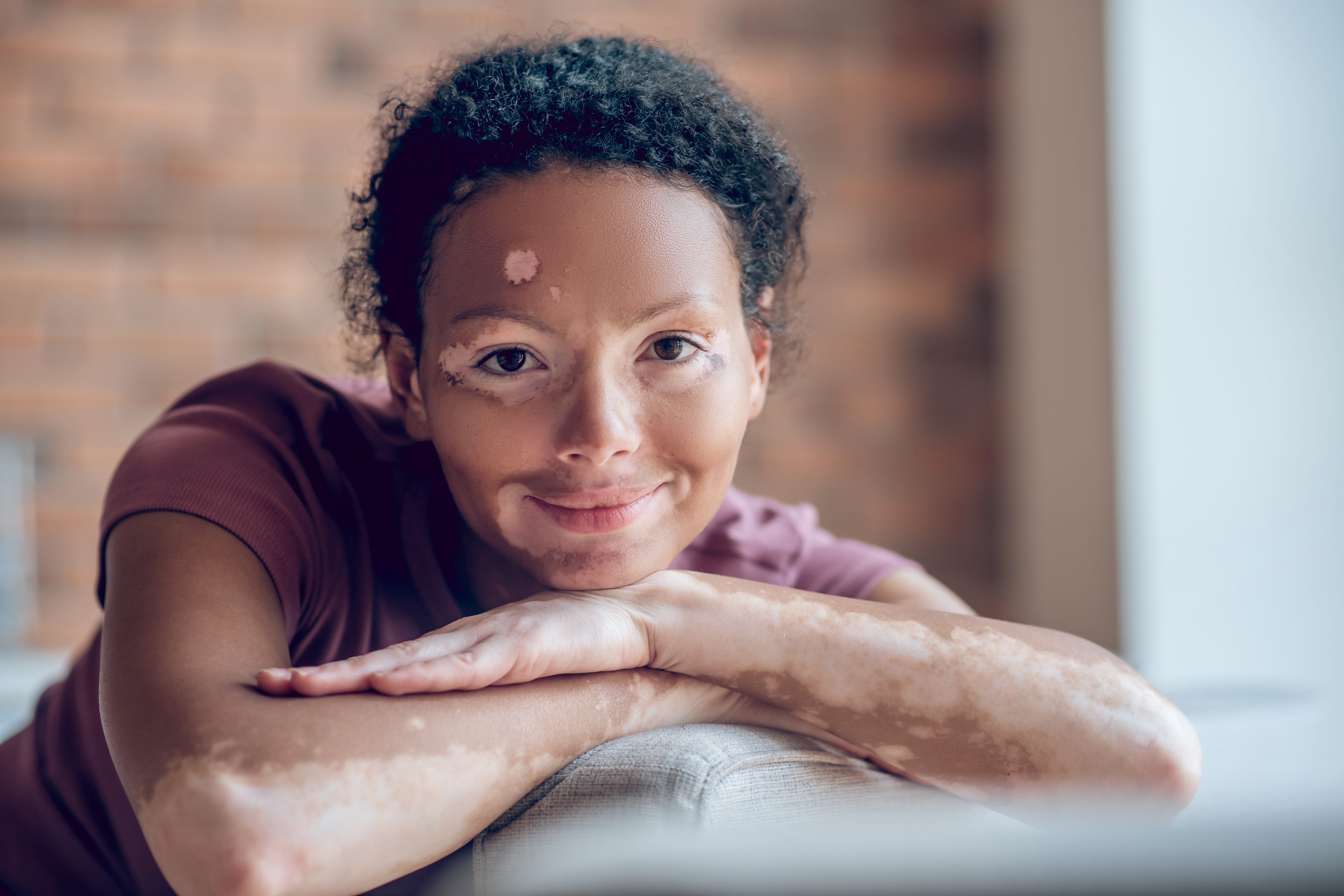
“They Tried to Erase Me”: How One Woman Survived Vitiligo, Bullying, and Culture That Profits From Shame
By the time I was nine years old, I understood that my skin made people uncomfortable.
My earliest memory of feeling different is standing in the school bathroom, scrubbing my hands until they were raw and red.
That is how Amina Rahman began to tell us her story, not with anger, but with precision. She remembers the fluorescent lights, the chipped sink, the smell of industrial soap. She was nine years old and convinced that if she washed hard enough, the pale patches spreading across her skin would disappear.
“They told me it looked dirty,” she says. “So I tried to clean it.”
Amina did not yet know the word vitiligo. She only knew that something about her body had marked her as a target.
Vitiligo is a non-contagious autoimmune condition that causes the loss of melanin, resulting in white patches on the skin. It affects people of all races, genders, and ages, yet remains widely misunderstood. For millions—particularly women and people of color—it is not just a medical condition but a social stigma, one enforced through bullying, exclusion, and institutional neglect.
Now 32 and living in Chicago, Amina is a public health advocate and anti-bullying organizer. She speaks openly about vitiligo, not because she enjoys vulnerability, but because silence once nearly erased her.
Her story exposes not just individual cruelty, but a broader failure—of schools, healthcare systems, media, and culture—to protect people whose bodies do not conform to rigid standards of “normal.”
A Childhood Defined by Scrutiny
Amina’s parents immigrated to the United States, believing education would shield their children from harm. Instead, school became the place where harm was first normalized.
“When the spots appeared, teachers asked if I’d been burned,” she recalls. “Other kids asked if I was sick. One parent told my mother I shouldn’t be allowed to sit near their child.”
By fifth grade, the comments escalated into mockery. By middle school, they became threats.
“They called me ‘zebra,’ ‘ghost,’ ‘patchwork,’” Amina says. “I was told I looked disgusting. I was told no one would ever love me.”
Bullying experts note that appearance-based harassment is among the most persistent and underreported forms of abuse in schools. Unlike race- or gender-based discrimination, it is often dismissed as teasing or “kids being kids,” leaving victims without protection or recourse.
Amina remembers reporting the bullying once.
“The counselor told me to ignore it,” she says. “That was the last time I asked for help.”
Before You Continue!
Stories like this require time, trust, and sustained investigative reporting. They exist because independent journalism chooses to listen where others look away—and because readers step up to support that work.
If you’re currently a free subscriber, upgrading to our annual plan helps us continue exposing harm, amplifying underreported voices, and holding institutions accountable. For a limited time, you can take full advantage of our 40% discount, making it easier than ever to support journalism that refuses to stay silent.
Your support doesn’t just keep us publishing—it strengthens our ability to investigate, to challenge power, and to ensure these stories are seen, shared, and acted on.
Click on the offer button below to upgrade now.
When Institutions Look Away
The damage of bullying is not limited to playground insults. It compounds when authority figures fail to intervene.
Investigations into school climate data show that students with visible differences—medical conditions, disabilities, skin disorders—are disproportionately targeted, yet least likely to see meaningful consequences imposed on perpetrators.
In Amina’s case, teachers witnessed classmates refusing to touch shared supplies after she used them. No correction followed. When rumors spread that vitiligo was contagious, no educational intervention occurred.
“That silence teaches everyone something,” Amina explains. “It teaches bullies they’re right. And it teaches victims that suffering is expected.”
Psychologists confirm that prolonged exposure to this kind of social rejection can alter a child’s self-concept permanently. Amina internalized the message.
“I started thinking my skin was a burden I brought into every room,” she says.
The Mental Health Cost of Being Visible
By high school, Amina mastered the art of disappearance. Long sleeves. Heavy makeup. Avoiding eye contact. Declining social invitations.
She developed anxiety attacks before presentations, terrified that classmates would stare at her hands instead of listening to her words.
Clinical studies link appearance-based bullying to elevated rates of depression, self-harm, and eating disorders, particularly among young women. For those with visible conditions, the body becomes both unavoidable and unsafe.
“I wasn’t bullied once or twice,” Amina says. “I lived inside it.”
At 16, she asked a dermatologist about treatments to “fix” her skin. She was presented with options that included steroids, experimental procedures, and bleaching her remaining pigment to make her skin uniformly white.
“No one asked how I felt,” she says. “They just assumed the goal was to erase the difference.”
Learning the Language of Resistance
The turning point came years later, during college, when Amina enrolled in a public health course focused on social determinants of health.
“For the first time, I saw vitiligo discussed without shame,” she says. “As data. As policy. As inequality.”
She learned that in many parts of the world, women with vitiligo face barriers to employment, marriage, and safety. In some cultures, the condition is falsely linked to moral impurity. In others, it becomes grounds for isolation or abuse.
“That’s when I understood,” Amina says. “This wasn’t about my skin. It was about power.”
She began researching medical bias, beauty standards, and how industries—from cosmetics to fashion—profit from convincing people that deviation requires correction.
Knowledge gave her something bullying had taken: agency.
Before You Continue!
Stories like this require time, trust, and sustained investigative reporting. They exist because independent journalism chooses to listen where others look away—and because readers step up to support that work.
If you’re currently a free subscriber, upgrading to our annual plan helps us continue exposing harm, amplifying underreported voices, and holding institutions accountable. For a limited time, you can take full advantage of our 40% discount, making it easier than ever to support journalism that refuses to stay silent.
Your support doesn’t just keep us publishing—it strengthens our ability to investigate, to challenge power, and to ensure these stories are seen, shared, and acted on.
Click on the offer button below to upgrade now.
Reclaiming Her Body, Publicly
In her early twenties, Amina made a decision that frightened her more than any insult ever had.
She stopped hiding.
She wore short sleeves. She let her makeup fade. And one night, she posted a photo online—unfiltered—of her hands.
The caption read:
This is vitiligo. It is autoimmune. It is not contagious. And it does not require permission to exist.
The response was immediate and overwhelming. Messages poured in from strangers who had never seen someone like themselves represented without apology. Parents wrote asking how to protect their children. Women shared stories they had never said aloud.
“That post changed my life,” Amina says. “Because it changed my understanding of impact.”
From Survival to Advocacy
Today, Amina works at the intersection of public health and education, advocating for policies that explicitly address appearance-based bullying.
She collaborates with schools to implement training that teaches staff how to intervene, not deflect. She consults with healthcare providers on trauma-informed care for patients with visible conditions. She speaks to policymakers about why anti-bullying frameworks must expand beyond narrow categories.
“Resilience is not a solution,” she says. “It’s a response to failure.”
Her work challenges a culture that loves stories of personal triumph but avoids systemic accountability.
“We celebrate individuals who ‘overcome,’” she adds. “But we don’t ask why they were harmed in the first place.”
Media, Beauty, and Conditional Acceptance
While vitiligo visibility has increased in recent years—most notably in fashion campaigns and social media—Amina warns against mistaking representation for justice.
“When vitiligo is shown, it’s often stylized,” she says. “It’s acceptable as long as it’s beautiful, thin, young, and rare.”
This framing reinforces the idea that difference must be extraordinary to be tolerated. Ordinary lives, ordinary bodies, remain invisible.
“What about the kids in public schools?” Amina asks. “What about women who don’t look like models?”
It Is Time to Act: Ending Bullying for Real
Amina’s story makes one truth unavoidable: bullying is not inevitable. It is permitted.
To dismantle it requires action at every level.
Schools must expand anti-bullying policies to include medical and appearance-based conditions explicitly. Educators must be trained to intervene immediately and consistently. Healthcare systems must stop treating differences as defects. Media must portray diversity without turning it into a spectacle.
And individuals must refuse silence.
“Correct misinformation,” Amina urges. “Call out cruelty. Teach your children that bodies are not debate topics.”
She pauses, then adds, “Bullying survives on witnesses who say nothing.”
Refusing Erasure
Amina no longer explains her skin unless she wants to. She no longer shrinks to make others comfortable. She no longer confuses cruelty with truth.
“I didn’t overcome bullying by becoming confident overnight,” she says. “I overcame it by understanding that I was never the problem.”
Her story is not inspirational. It is instructive.
It shows us what happens when difference is punished—and what becomes possible when someone refuses to disappear.
And it leaves us with a question that demands more than sympathy:
If we know bullying destroys lives, why do we still allow it to thrive?
Until that question is answered with action, stories like Amina’s will remain necessary—not because they are rare, but because they are still happening.
Before You Click Away!
Stories like this require time, trust, and sustained investigative reporting. They exist because independent journalism chooses to listen where others look away—and because readers step up to support that work.
If you’re currently a free subscriber, upgrading to our annual plan helps us continue exposing harm, amplifying underreported voices, and holding institutions accountable. For a limited time, you can take full advantage of our 40% discount, making it easier than ever to support journalism that refuses to stay silent.
Your support doesn’t just keep us publishing—it strengthens our ability to investigate, to challenge power, and to ensure these stories are seen, shared, and acted on.


Wow! What an eye opening article, and concise description of how simple medical conditions draw such hatred and cruelty upon the patient and why it continues. I do believe training is key. How often were we all told to ignore the bullies? It has never worked and never will, but I think given the tools and perspective we can overcome ignorance, cruelty, and shame, in many cases at least. Allowing the bullies to go unchecked is truly a systemic failure on the part of our society and all of us. We need to learn better to stick together and show courage when faced with this behavior, and that needs to start with understanding and support, not exclusion.
Currently at the ER where I’m actually being treated like a person instead of a Fat Grandma With Medicaid