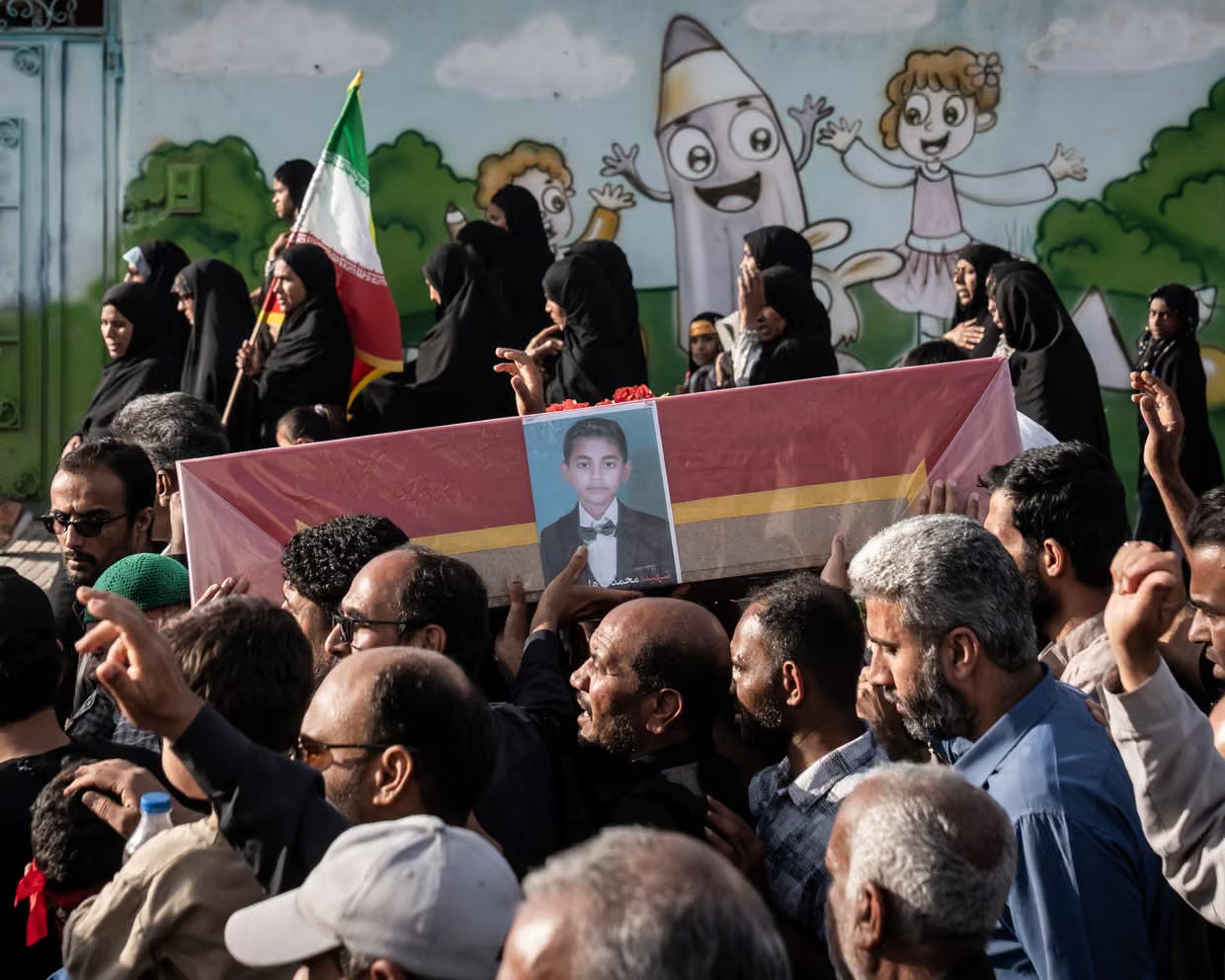
Trump Spends $2bn (£1.5bn) a Week On A ‘reckless’ Iran War, While 87 Million Lives, Including Americans, Hang in the Balance.
Head of UN’s humanitarian agency frustrated that $2bn weekly cost of conflict comes amid big cuts to aid budgets

The numbers are staggering—and damning.
At a time when Americans can’t make ends meet, or humanitarian systems are collapsing under the weight of global crises, the United Nations says the money being poured into a ‘reckless’ Iran war could have rewritten the fate of tens of millions of people.
Speaking Monday, UN humanitarian chief Tom Fletcher delivered a blunt reality: the $2bn (£1.5bn) per week spent by Donald Trump on a ‘reckless’ war in Iran could have funded efforts to save more than 87 million lives, among them are Americans.
That’s not a projection.
That’s not theory.
That was a real, achievable plan—now out of reach.
And for Tom Fletcher, the frustration is no longer diplomatic. It’s urgent.
While bombs are funded without hesitation, American families are barely making ends meet. Aid programs are being gutted. The very systems designed to keep people alive are being starved of resources—cut by nearly half—at the exact moment they are needed most.
But the warning didn’t stop at money.
Fletcher also sounded the alarm on something equally dangerous: the normalization of violent, dehumanizing language at the highest levels of power.
Threats to “bomb Iran back to the stone ages,” he said, are not just reckless—they are contagious.
They create a permission structure.
They tell every rising strongman, every authoritarian waiting in the wings, that this is acceptable. That targeting civilians, destroying infrastructure, and violating international law can be framed as strength instead of what it is: devastation.
And history shows what happens when that line disappears.
Speaking at Chatham House in London, Fletcher turned his attention to the United Kingdom, delivering a critique just as sharp. For more than a decade, he said, British politics has been trapped in a self-destructive cycle—a “circular firing squad” that has eroded its global standing and left it hesitant, diminished, and defensive.
The consequences are visible.

Once a leader in global aid, the UK is now facing quiet embarrassment on the international stage. Fletcher noted that at global conferences, Britain’s claims of leadership are increasingly met with disbelief—even laughter—after deep and sustained cuts to its aid budget.
Behind that criticism is a deeper crisis.
Fletcher is currently overseeing what he describes as a “cataclysmic” collapse in humanitarian funding. His agency is operating with a 50% budget reduction. The target to save 87 million lives sits at $23 billion—but he is already $10 billion short.
And the cuts are not isolated.
They are being driven by a broader shift—one in which governments are prioritizing military spending and domestic political priorities over international responsibility. The United States, once the backbone of humanitarian funding, has pulled back significantly. Europe is following the same path.
The result is a system under strain—and millions of lives pushed closer to the edge.
The war in Iran is already amplifying that pressure globally. Rising food and fuel costs, nearing 20% inflation in some regions, are expected to hit the most vulnerable the hardest. Fletcher warned that the long-term consequences will be felt across sub-Saharan Africa and East Africa, where poverty is set to deepen dramatically.

“For every single day of this reckless war, $2 billion is spent,” Fletcher said. “We could have funded a plan to save 87 million lives in less than two weeks. That window is gone.”
And with it, a stark question remains: what are global priorities really aligned to?
Fletcher also pulled back the curtain on the difficult dynamics shaping international decision-making. He described the UN’s relationship with the Trump administration as unpredictable—“an absolute rollercoaster ride”—but not without progress.
He has worked to challenge the perception of the UN as ineffective, pushing back against the idea that it is simply a slow-moving bureaucracy detached from real-world impact.
Still, he acknowledged a deeper divide in worldview.
“There is a difference between statecraft and what I would call real-estatecraft,” Fletcher said.
Where traditional diplomacy values process, structure, and long-term stability, many in the Trump administration—coming from business backgrounds—prioritize instinct, personal trust, and speed.
In their world, the handshake comes first. The deal comes later.
It’s a model built less on institutions and more on relationships. Less on predictability, more on disruption.
“They believe unpredictability creates leverage,” Fletcher said. “That keeping allies and adversaries off balance produces results. We’ll see if that proves true.”
Still, he left the door open to results. “If 14 wars are ended, then yes—bring on the Nobel Peace Prizes,” he said. “But let’s see them actually end.”
Behind the scenes, Fletcher is grappling with decisions that go far beyond strategy—they are moral.
He revealed he is losing sleep over whether to accept US funding if it comes with conditions tied to issues like abortion or transgender rights.
The dilemma is stark: accept the money and save lives, or reject it on principle.
“The question is real,” he said. “Do we take that funding, knowing it will save millions, or do we refuse because of the conditions attached?”
For now, Fletcher indicated he is not prepared to accept those terms.
At a structural level, he warned that the entire postwar international system is under pressure. The UN Security Council, once a central mechanism for maintaining global peace, is now deeply divided—paralyzed by competing interests and transactional politics.
Instead of cooperation, there is fragmentation.
Instead of shared responsibility, there is retreat.
And the numbers tell the story.
“If I were running an organization that dropped from $50 billion to $20 billion in a year, I would be fired,” Fletcher said. “The needs are rising. The funding is falling. That is failure—and we have to confront it.”
He made clear that while US cuts have had the largest impact—given its previous contribution of up to 45%—the responsibility does not stop there.
Across Europe, governments are scaling back.
In the UK, the long-standing commitment to spend 0.7% of national income on aid—a policy that once defined its global leadership—has been effectively dismantled.
The financial savings, Fletcher argued, are minimal in the context of national budgets. But the human cost is enormous.
And the signal it sends is even more powerful.
When countries like the UK step back, others follow.
It creates a chain reaction—one that leaves the most vulnerable with fewer lifelines and fewer allies.
Fletcher returned to his warning about Britain’s internal divisions, describing a decade-long period of political infighting that has weakened its voice and its vision.
“At some point, the UK has to step out of this cycle,” he said. “It cannot remain in a defensive crouch forever.”
He also raised concerns about the erosion of the country’s broader strengths since 2016—its global influence, its cultural reach, its institutions, and its soft power.
“The UK has been damaging some of its most valuable assets,” he said. “Too confident where it should be cautious. Too quiet where it should lead.”
In a moment like this, he argued, what the world needs is not noise—but steady, competent leadership.
Finally, Fletcher turned to a crisis that receives far less attention: the growing danger faced by humanitarian workers themselves.
More than 1,000 have been killed in the past three years. Many were targeted by drones.
These are not combatants. They are the ones responding to disaster—the equivalent of firefighters and paramedics in war zones.
And yet, they are being killed at alarming rates—with little accountability.
“We are the emergency responders of global crises,” Fletcher said. “And somehow, it has become acceptable that we are being killed in these numbers.”
His message to world leaders was direct—and urgent.
Stop issuing empty statements.
Stop hiding behind generic language.
Make the calls. Name those responsible. And stop arming those carrying out these attacks.
Because in the end, the cost of inaction is not abstract.
It is counted in lives not saved—and in a world that grows more unstable with every passing day.


Warum lassen sich die Amerikaner das gefallen?
🤡💀😡👹🤦💯
