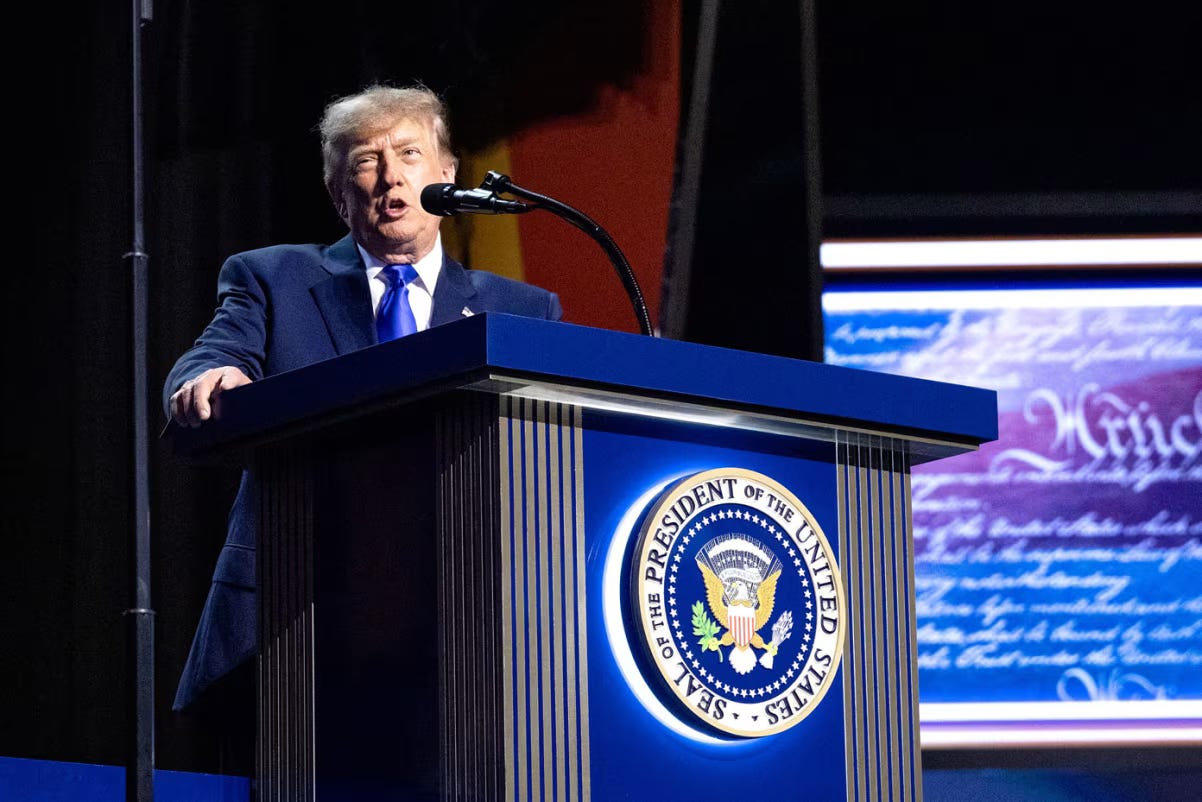
Donald Trump wants Americans to believe there is a lot riding on Republican victory in November. Their borders, their security, their wealth and perhaps even the future of the country are all supposedly at stake. Now the president has added something considerably more personal to that list: $5,000.
Speaking at the Republican midterm convention in Dallas, Trump pledged that every adult US citizen would receive $5,000 if Republicans retain control of the House and Senate. It was the sort of announcement almost guaranteed to dominate headlines, not least because delivering it would cost the federal government more than $1tn. But the most remarkable part of Trump’s promise was not the staggering price tag. It was the condition he publicly attached to it.
“If the Republicans win, you win with us, and you get $5,000,” Trump told supporters.
There was little ambiguity in the political message. Republicans win the midterms, and Americans get the money. Republicans lose and, according to Trump’s formulation, they don’t.
Politicians have always promised economic benefits during election campaigns. Democrats campaign on healthcare spending, social programs and tax credits; Republicans campaign on tax reductions, deregulation and other measures they argue will leave Americans richer. There is nothing inherently corrupt about telling voters that electing one party will produce economic policies that benefit them.
Trump’s formulation, however, deserves much closer scrutiny because it was so explicitly transactional. He did not simply unveil a $5,000 proposal and ask Congress to consider it on its merits. He presented the payment as something Americans would receive if Republicans win.
For a president already notorious for his unwillingness to accept an electoral defeat, that distinction should set alarm bells ringing.
There is no evidence in Trump’s Dallas speech that he is secretly altering ballots or manipulating vote counts, and accusing anyone of literally stealing an election requires evidence. But cheating democracy can involve more than fraudulent ballots. The more immediate concern raised by Trump’s remarks is whether the enormous powers, promises and resources associated with the presidency are being increasingly treated as instruments for keeping one political movement in control.
His $5,000 offer brings that concern into unusually sharp focus.
If Americans deserve the money, why should Republican victory determine whether they receive it?
If the proposal is legitimate economic policy, why not introduce it regardless of who controls Congress after November?
And if the administration has identified more than $1tn that can responsibly be distributed to American citizens, where is the detailed proposal explaining how it will be financed?
Those questions matter because public money belongs to the American people. It does not belong to Donald Trump, the Republican Party or whichever political movement happens to occupy the White House. A president suggesting that citizens will receive a substantial financial benefit if they deliver his party an electoral victory risks turning government policy into something resembling a political reward.
That is precisely where Trump’s rhetoric becomes dangerous.
The president did not stop with the promise of money. During his nearly two-hour address, he repeatedly presented the midterms as an existential choice between Republican rule and national disaster, warning that a Democratic victory would cost Americans their border, tax cuts, security and wealth.
“If we lose, you’re going to lose your border, you’re going to lose your tax cuts, you’re going to lose your safety and security, you’re going to lose your wealth,” Trump said.
He warned of America going through “hell” and declared that Republicans would “defeat communism in America”.
Taken together, the political strategy was difficult to miss. Trump offered voters a potentially enormous financial reward if Republicans win while painting the alternative as economic and national catastrophe.
It is a remarkable combination of incentive and fear.
And behind it lies an uncomfortable political reality: Republicans have reason to worry about November.
The party holding the White House historically faces difficulties in midterm elections, and Republicans are fighting to retain control of Congress at a time when Trump remains deeply unpopular with a large portion of the electorate. Some Republican politicians in competitive races stayed away from the Dallas gathering altogether, an indication that the president who remains dominant inside the Republican Party can still become a liability when candidates have to appeal beyond his most loyal supporters.
Trump’s solution appears to be to make the election even more about himself.
“Pretend that I’m on the ballot,” he urged voters.
That request may have revealed more about the stakes of November than much of the rest of his speech.

Trump is not on the ballot, but his power effectively is. A Republican Congress would give his administration considerably greater freedom to pursue its agenda during the remainder of his presidency. A Congress controlled in whole or in part by Democrats could bring investigations, subpoenas, aggressive oversight and legislative resistance.
Trump therefore has an enormous personal and political interest in the outcome.
None of that is unusual by itself. Every president wants congressional allies. What makes Trump’s situation different is his history of treating electoral defeat not simply as rejection by voters but as evidence that the democratic process itself must somehow have failed.
After losing the 2020 presidential election, Trump refused to concede in the traditional manner and spent weeks promoting allegations of widespread fraud. His campaign and allies pursued legal challenges that failed to produce evidence sufficient to overturn the result. Trump pressured officials as he attempted to remain in power, while allies pursued an alternative-elector strategy. The effort culminated in the extraordinary events of 6 January 2021, when his supporters stormed the US Capitol as Congress met to certify Joe Biden’s victory.
That history cannot simply be erased when evaluating Trump’s behavior around another consequential election.
It does not prove that Trump is currently rigging the 2026 midterms. But it provides ample reason for journalists, election officials and voters to scrutinize attempts to change election rules, manipulate political institutions or condition government benefits on partisan victory.
The danger is that Americans have become accustomed to thinking about “stealing an election” almost exclusively in terms of fraudulent vote counting. Democratic systems can be distorted much earlier than election night.
Congressional districts can be aggressively redrawn for partisan advantage. Voting rules can be rewritten. Registration and voter-roll policies can become political battlegrounds. Particular methods of voting can be restricted or expanded. Government institutions can be deployed in ways that benefit the party controlling them. Politicians can also spend months convincing supporters that an election is illegitimate unless their side wins, ensuring that defeat itself becomes supposed evidence of cheating.
Not every one of those actions is illegal, and both major parties have fought aggressively over election rules and redistricting. But legality is not the only measure of democratic health. A political system can remain technically within the boundaries of law while becoming progressively less fair, less trusted and more vulnerable to manipulation.
That is why Trump’s $5,000 promise deserves more than ridicule.


Imagine for a moment that a Democratic president had made precisely the same announcement. Imagine Barack Obama or Joe Biden standing before a Democratic convention and telling the country that if Democrats retained the House and Senate, every adult American would receive $5,000.
Republicans would almost certainly call for investigations. Conservative media would spend weeks debating whether Democrats were attempting to buy an election with taxpayers’ money. Questions about bribery, abuse of power and election interference would dominate Washington.
Trump should not receive a different standard simply because Americans have grown accustomed to behavior from him that would once have been considered politically extraordinary.
The question is not whether voters can legally support Republicans after hearing the proposal. Of course they can. Nor does promising an economic benefit automatically amount to buying votes. The question is whether a president should explicitly condition a massive government payout on voters delivering congressional power to his political party.
If Trump’s proposal is good for America, he should make the case for it as policy rather than as a prize for Republican victory.
The atmosphere surrounding the Dallas convention made the president’s desperation to project political strength even more striking. Trump boasted about the success of his second term and presented himself as the indispensable figure in Republican politics, yet visible sections of the convention hall remained empty. He nevertheless claimed the arena was packed and asserted that an equal number of people were outside, something reporters at the event said they did not observe.
It was a small episode, but a familiar one: Trump’s political power has long depended on his extraordinary ability to insist upon his version of reality even when observable facts complicate it.
That tendency becomes considerably more consequential when elections are involved.
An empty seat can be declared occupied without much consequence. An electoral defeat cannot.
America learned that after 2020.
That is why the months between now and November deserve intense scrutiny. If Trump and Republicans win the midterms fairly, Democrats should accept the result. If Democrats win fairly, Trump and Republicans must do exactly the same. Claims of cheating from either side should require evidence rather than partisan suspicion.
But accepting legitimate results does not mean ignoring conduct before votes are counted. Journalists and voters should watch how election laws are changed, how congressional maps are drawn, how voter-registration disputes are handled, how federal authority interacts with state election systems and whether attempts are made to disqualify legitimately cast ballots.
And they should pay attention when the president of the United States tells citizens that Republican victory could make each of them $5,000 richer.
The most disturbing aspect of Trump’s announcement may ultimately have little to do with whether the payment ever materializes. Congress may never approve it. The administration may never identify a credible way to finance it. Trump himself may eventually abandon or transform the proposal.
But the political precedent remains troubling.
Government is supposed to serve Americans whether they vote Republican, Democratic, independent or not at all. Federal money should never be treated as though it belongs to the governing party, available to be dangled before citizens as a reward for keeping that party in power.
Trump has asked Americans to “pretend that I’m on the ballot” this November.
Perhaps voters should take that request seriously.
They should remember how he responded the last time the country told him no. They should remember the attempts to overturn the 2020 result. They should scrutinize every effort by either party to manipulate the rules governing November. And they should be deeply suspicious whenever presidential power and public money begin to blur into partisan electoral machinery.
The real test of American democracy is not whether Donald Trump desperately wants Republicans to win. Of course he does. The test is whether he is willing to accept their defeat if American voters choose otherwise.
His history makes that question impossible to dismiss.
And now, with Trump effectively telling American adults that Republican victory could be worth $5,000 to them personally, another question deserves to be asked: when keeping power becomes the overriding objective, where exactly does campaigning end and an attempt to game democracy begin?


A $5,000 promise. Like a no foreign wars promise. Like prices going down on everything on day one promise. Like the war between Russia and Ukraine and Israel and Palestine being settled on day one promise.
