Trump's Real State of the Union: Most Americans Are Barely Surviving, Barely Getting By.
Trump painted a picture of prosperity — but across the country, working families are drowning in rising costs and shrinking breathing room.

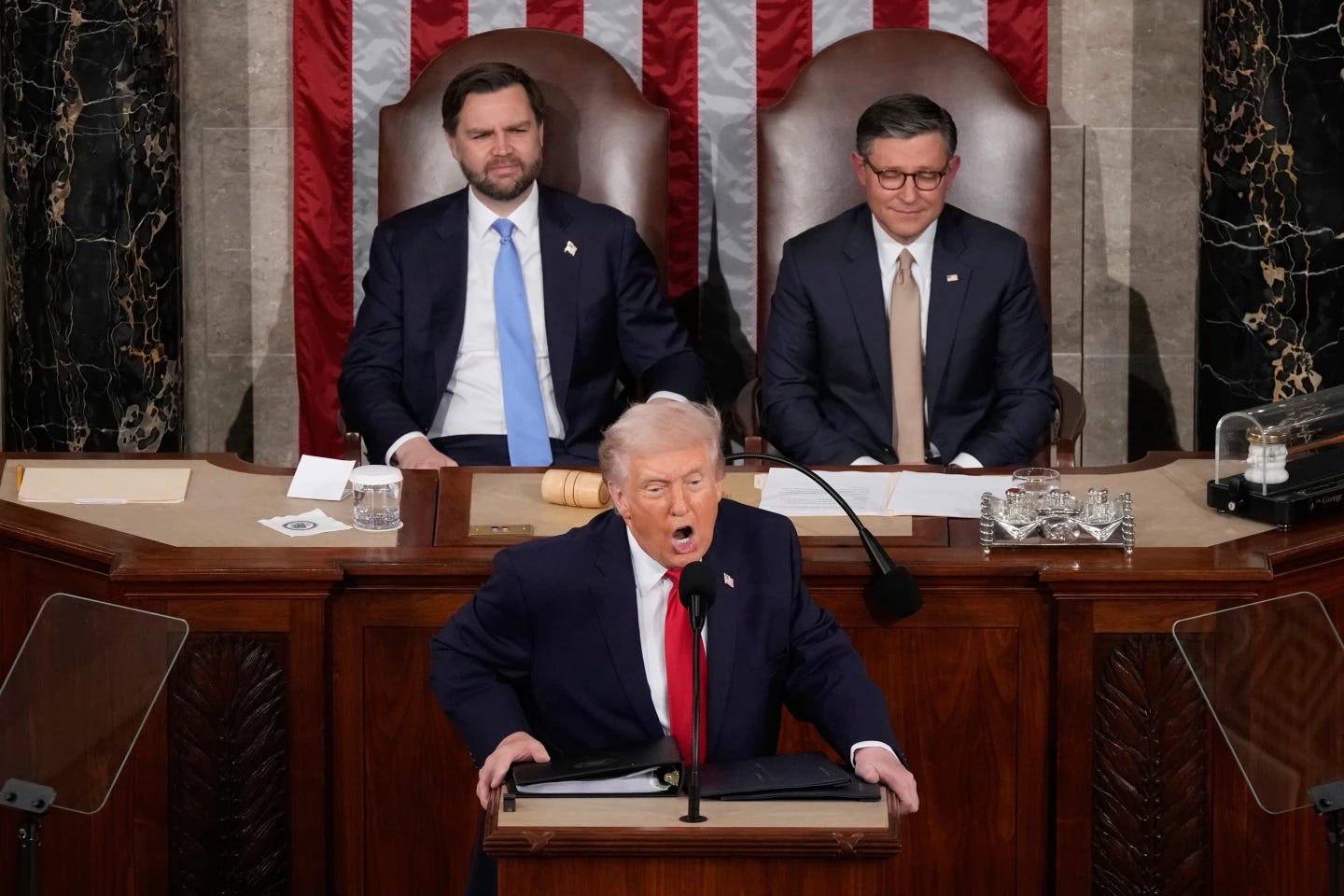
Last night, Donald Trump delivered his official State of the Union address, marking his first formal SOTU since returning to office. He strode into the House chamber and delivered what was meant to be a victory speech. The message was unmistakable: America is back, the economy is booming, and under his leadership the country is stronger than ever.
It was classic Trump — confident, combative, and carefully choreographed for maximum political effect.
But outside the walls of Congress, the mood in America is far less celebratory.
Because while Trump painted a portrait of national renewal, millions of Americans are still stuck in a far grimmer reality: rising bills, shrinking savings, and a growing fear that no matter how hard they work, they are barely staying afloat.
If tonight’s speech was about perception, the real State of the Union is about pressure — financial pressure that will not let up.
The Economy Trump Says Is “Roaring”
Trump opened with familiar bravado, declaring that the American economy is “roaring back” and stronger than at any point in recent years. He cited job creation, manufacturing gains, and market performance as proof that his policies are delivering.
On paper, some of those indicators do show resilience. Unemployment remains relatively low. Certain sectors have added jobs. Markets have held steady.
But presidential speeches are not judged by spreadsheets. They are judged by the daily lived experience of Americans.
And right now, millions of working families are asking a simple question the speech did not fully answer:
If the economy is so strong, why does everything still feel so expensive?
The Tariff Gambit Returns

One of the most eyebrow-raising moments of the address came when Trump revived a sweeping economic promise — the idea that tariffs on foreign imports could eventually replace Americans’ income taxes.
It is a politically seductive concept. Who wouldn’t want to eliminate income taxes?
Trump framed tariffs as a tool to make other countries “pay their fair share,” while protecting American workers and industries.
But here’s the uncomfortable reality: tariffs are typically paid by American importers and businesses, costs that often get passed directly to consumers.
In plain English, tariffs can function like a hidden tax on American households.
Even many conservative economists remain skeptical that tariff revenue could come anywhere close to replacing income taxes. The math simply does not cooperate with the rhetoric.
Yet the applause line landed — because in the theater of the State of the Union, political appeal often outruns fiscal reality.
Immigration Takes Center Stage — Again


As expected, Trump devoted significant time to immigration, one of the defining pillars of his political brand.
He touted aggressive border enforcement, promised further crackdowns on illegal crossings, and framed his administration’s approach as essential to national security and economic stability.
Supporters in the chamber erupted in approval.
But critics note that while immigration dominates political messaging, it does little to address the cost-of-living crisis squeezing American households.
Border policy may energize the base. It does not lower grocery prices.
A Hard Line on Crime and Law Enforcement

Trump also leaned heavily into law-and-order themes, praising police departments and promising tougher action against violent crime.
He described American cities as safer under his watch and vowed continued federal support for law enforcement.
Crime messaging has long been a powerful political tool, particularly in election cycles. But again, it operates largely in a different lane than the economic anxiety dominating kitchen-table conversations.
For many families, the fear keeping them up at night is not crime — it is whether the paycheck will stretch to the end of the month.
The Inflation Claim vs. Household Reality
Perhaps the most contentious thread running through Trump’s speech was his continued insistence that inflation is under control and the worst price pressures are behind us.
Technically, inflation has cooled from earlier peaks.
But cooling inflation is not the same thing as affordable living.
Prices that surged in previous years have largely stayed elevated. Rent is still high. Insurance premiums are still climbing. Grocery totals still sting.
This is the distinction many political speeches blur — and many households feel acutely.
When a family’s weekly grocery bill jumps from $150 to $210 and stays there, being told inflation is “down” offers little comfort.
The pain is cumulative. And it lingers.
The Manufacturing Revival Narrative
Trump also highlighted efforts to bring manufacturing back to American soil, framing it as a cornerstone of his economic strategy.
There is some movement in this area. Certain domestic investments have increased, and reshoring has become a bipartisan talking point.
But manufacturing job growth alone cannot offset the broader affordability crunch hitting service workers, gig workers, and middle-income families in high-cost regions.
The economic story is uneven — something the speech largely glossed over.
Political Theater in the Chamber

As with many modern State of the Union addresses, the night was as much about political optics as policy substance.
Republicans offered repeated standing ovations. Some Democrats sat stone-faced. A few moments of visible tension punctuated the evening.
Trump, ever the showman, leaned into the drama — honoring select guests, delivering sharp partisan jabs, and framing his administration as the last line of defense against national decline.
It was effective television.
But compelling television does not pay the rent.
The Voter Confidence Problem
Here is the political iceberg beneath tonight’s speech: voter confidence on affordability remains deeply shaky.
Across income brackets, Americans continue to report feeling financially squeezed. Many say their wages have not kept pace with the cost of living. Others report dipping into savings or carrying higher credit card balances.
This disconnect — between macroeconomic claims and household reality — is where political trouble tends to brew.
Presidents rarely lose support because of one bad data point. They lose it when voters feel persistently unheard.
What the Speech Didn’t Fully Confront
To be fair, not every affordability challenge began under Trump. Housing shortages, healthcare costs, and insurance inflation have been building for years.
But leadership is measured in outcomes, not inheritance.
And last night’s address largely sidestepped several stubborn pressures still weighing on Americans:
Housing affordability remains strained
Childcare costs continue to bite
Consumer debt is elevated
First-time homeownership remains out of reach for many
Insurance premiums keep climbing
Until those pressures ease in ways families can actually feel, the administration’s optimistic framing may continue to face resistance.
The Midterm Message Behind the Speech

Make no mistake: this was not just a State of the Union. It was a political positioning exercise ahead of the next electoral battles.
Trump’s goal was clear:
Project strength.
Project momentum.
Project economic confidence.
For his base, the speech likely reinforced existing support.
But for swing voters and financially stressed households, the question remains unsettled.
Confidence is not declared from a podium. It is experienced at the checkout line.
The Real State of the Union


Strip away the applause, the pageantry, and the partisan theater, and a more complicated picture emerges.
Yes, parts of the economy are stable.
Yes, job growth exists in key sectors.
Yes, markets have shown resilience.
But millions of Americans are still living paycheck to paycheck. Many are working longer hours just to maintain the same standard of living they had a few years ago.
They are not looking for rhetorical victories.
They are looking for breathing room.
Bottom Line: The Credibility Gap
Trump delivered the speech he wanted to deliver — forceful, optimistic, and politically sharp.
But the real test is not how the speech sounded inside the chamber.
It is how it lands in living rooms across the country.
If rent keeps rising…
If groceries keep climbing…
If insurance keeps squeezing household budgets…
Then no amount of presidential confidence will fully close the credibility gap.
Because the true State of the Union is not measured in applause lines.
It is measured by whether ordinary Americans feel secure in their own financial lives.
And last night, for far too many families, survival still feels harder than it should in the richest country on earth.