
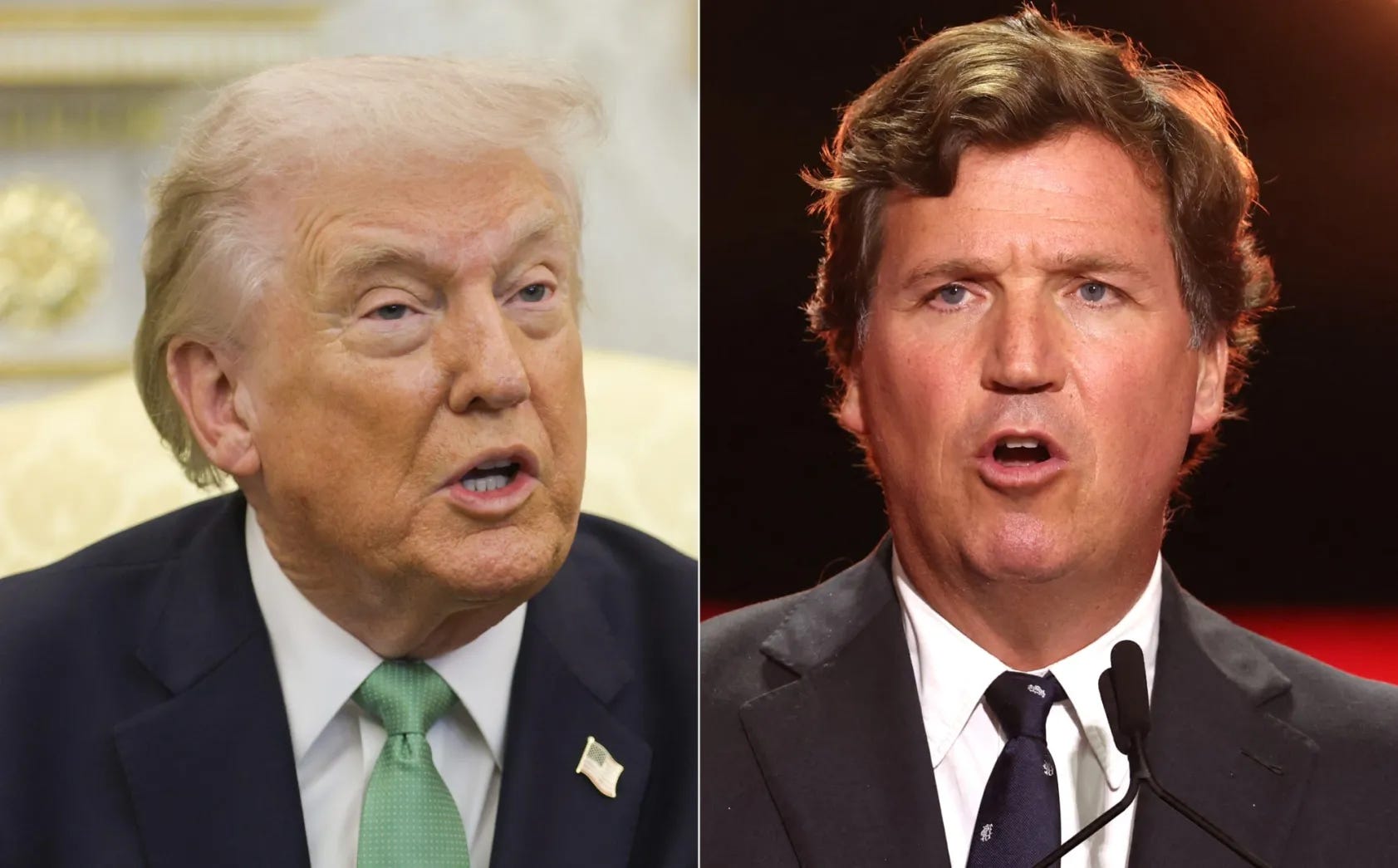
Tucker Carlson, another Trump’s Douchebag, apologizes for Backing Trump as the rift deepens.
Conservative host tells brother “we’re implicated,” calls support for president a moral failure amid escalating feud.
A growing fracture between Donald Trump and Tucker Carlson spilled further into public view Monday, as the conservative host openly acknowledged his role in helping elevate the president—framing it as a mistake he now has to answer for.
During an episode of The Tucker Carlson Show, Carlson sat down with his brother, Buckley Carlson, a Republican operative and former Trump speechwriter. What unfolded was less a typical political discussion and more a moment of reflection—one centered on accountability.
“You wrote speeches for him. I campaigned for him. We’re implicated in this,” Carlson admitted. “It’s not enough to just say you’ve changed your mind and walk away.”
The remarks signal a notable shift from Carlson, who for years stood as one of Trump’s most influential media allies. Now, as tensions between the two escalate, Carlson appears to be confronting the consequences of that support more directly.
“In small but real ways, people like us helped make this happen,” he continued. “That’s something you don’t just shake off. I’ll carry that. And I do want to say I’m sorry for misleading people—it wasn’t intentional.”
The conversation revisited the early days of Trump’s political rise, when his refusal to conform to traditional political norms drew in supporters across conservative circles. Buckley Carlson described being pulled in by that defiance, eventually joining Trump’s orbit and contributing as a speechwriter.
But both brothers suggested that what once felt like disruption of a stagnant system gradually shifted into something more troubling—marking a departure from traditional conservative values in favor of a more aggressive populist movement.
Carlson himself played a key role in that transformation, using his platform to amplify Trump’s message and, at times, legitimize his candidacy to a broader audience.
The discussion also turned to the aftermath of the 2020 election, with both Carlsons continuing to question its outcome—a claim widely rejected by courts and election officials—while criticizing Trump’s response during that period.
According to Buckley Carlson, Trump’s messaging failed to resonate.
“He kept repeating talking points that weren’t compelling and ended up making him look unsteady,” he said, adding that Trump ultimately failed to use the authority he still had at the time.
Carlson’s break with Trump has become more pronounced in recent months, particularly over foreign policy. He has sharply criticized Trump’s rhetoric toward Iran, as well as his strong backing of Israel’s military actions, previously describing the language used as “vile.”
Trump responded with characteristic force, taking to Truth Social to lash out at Carlson, calling him “low IQ,” “overrated,” and “easy to beat.” The president also broadened his attacks to include other right-wing media figures such as Candace Owens, Megyn Kelly, and Alex Jones.
Still, Carlson framed his comments less as a political attack and more as a personal reckoning.
He acknowledged that concerns about Trump’s character were never entirely absent—but were ultimately overlooked.
“There were always signs,” Carlson said. “But people can rise above that. I’ve done it myself at times. You try to be better than your flaws.”
Now, however, that belief appears to have faded.
What remains is a rare moment: a prominent former ally publicly grappling with his role in Trump’s rise—at a time when the divide between them is no longer just political, but deeply personal.


