



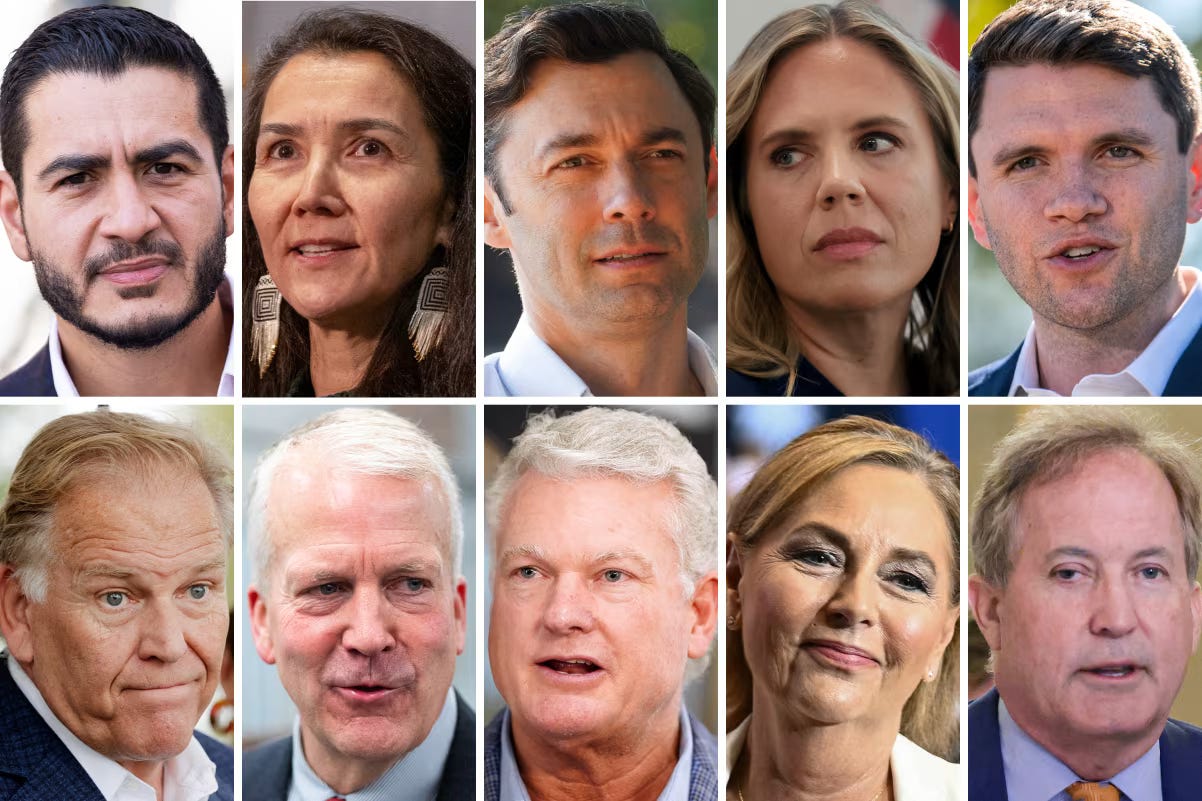
The US midterm elections are set to become the most expensive on record, with total spending projected to reach nearly $12 billion, according to OpenSecrets, an independent nonprofit organization that tracks campaign financing.
Much of the spending is being driven by outside political groups, known as Super Political Action Committees (Super PACs), pouring enormous sums into key congressional races ahead of Election Day on November 3.
The largest individual donor is billionaire businessman Elon Musk, who has reportedly contributed approximately $474 million to political organizations, largely to help Donald Trump and the Republican Party maintain their grip on political power.
Nearly half a billion dollars from one man to influence the outcome of an election. Let that sink in.
Meanwhile, as nearly $12 billion is being poured into political campaigns filled with promises that may never materialize, millions of Americans are:
Living paycheck to paycheck.
Struggling with the rising cost of living.
Unable to afford adequate healthcare.
Relying on food assistance to survive.
Facing homelessness and housing insecurity.
Witnessing continued violence, discrimination, and attacks on women’s rights.
Watching LGBTQ+ communities face discrimination and threats to their fundamental rights.
The problems are countless, yet the political establishment appears more concerned with winning elections than addressing the suffering of ordinary Americans.
If this is not one of the most profoundly dishonest and compromised political systems in the democratic world, what is?
The Billionaires’ Democracy: Follow the Money.
The deeper you investigate America’s campaign-finance system, the more disturbing the picture becomes.
According to OpenSecrets, outside political spending is projected to reach $3.9 billion in 2026, compared with approximately $2 billion during the 2022 midterms.
Even more alarming, nearly $1.47 billion in dark-money contributions has already been identified.
Dark money allows wealthy interests to influence elections through organizations that do not publicly disclose their original donors.
Think about the implications.
Ordinary Americans are expected to disclose their income, pay their taxes, and comply with financial regulations. Yet wealthy interests can channel enormous sums into the political process without voters necessarily knowing who ultimately provided the money.
Who are these donors?
What do they want?
Which politicians benefit from their financial support?
And what happens when the interests of those donors conflict with the needs of ordinary Americans?
These are not conspiracy theories. They are legitimate questions about a political-financing structure that permits extraordinary concentrations of influence.
Before You Continue!
Independent Journalism Needs Your Support.
While powerful interests spend billions shaping political narratives, we believe journalism should serve the people, not the powerful. If you believe in fearless reporting, uncomfortable truths, and holding power accountable, upgrade to a paid subscription today. Your support helps us remain independent, amplify unheard voices, and keep asking the questions others would rather ignore.
Support independent journalism. Become a paid subscriber.
When Corporate Interests Become Political Priorities.
An August investigation by Reuters identified cryptocurrency companies, artificial intelligence businesses, and online betting firms among the emerging financial powerhouses influencing the 2026 midterm elections.
These industries have substantial interests in government regulation, taxation, and legislation.
Are Americans supposed to believe that corporations spend millions influencing elections purely out of patriotic generosity?
Political contributions do not automatically establish bribery or illegal corruption. But the potential for conflicts of interest deserves relentless scrutiny.
When a corporation contributes millions to political organizations, does it receive greater access to decision-makers?
When legislation threatens powerful business interests, whose concerns receive priority?
And when ordinary Americans demand affordable healthcare, better wages, or stronger consumer protections, who is listening?
A democracy should never require citizens to become billionaires before their concerns are taken seriously.
Yet America’s campaign-finance system increasingly raises precisely that concern.
The American Dream Is Becoming a Financial Nightmare.

While political organizations compete to spend billions, the economic reality confronting millions of Americans is devastating.
An October 2026 Pew Research Center study found that 60% of American adults said their income was insufficient to support the standard of living they wanted.
More troubling, 27% reported being unable to pay some monthly bills in full, while 53% lacked emergency savings sufficient to cover three months of expenses.
And 28% experienced difficulty paying for medical care during the previous year.
These are not imaginary problems invented by political opponents.
They are documented financial struggles affecting real families.
Imagine a mother working full-time, calculating whether she can afford groceries after paying rent.
Imagine a father postponing medical treatment because the bill could destroy his family’s finances.
Imagine young Americans entering adulthood already questioning whether they will ever afford a home.
Now imagine watching political advertisements funded by billionaires promising that prosperity is just one more election away.
How insulting must that feel?
The Political Establishment Has Mastered the Art of Selling False Hope.
Every election season, politicians rediscover America’s struggling families.
They visit factories, embrace workers, promise affordable healthcare, and declare themselves champions of ordinary people.
Then the election ends.
The advertisements disappear. The cameras move elsewhere. And Americans are left measuring political promises against their everyday realities.
Republicans blame Democrats.
Democrats blame Republicans.
Both parties have different policy agendas, but both participate in a political-finance system heavily influenced by wealthy donors and powerful organizations.
The question is not whether every politician is corrupt. That would be an indefensible accusation.
The question is why a system supposedly designed to represent ordinary citizens depends so heavily on extraordinary private wealth.
How can political equality flourish when financial influence is distributed so unequally?
And why should Americans accept endless campaign promises without demanding measurable accountability?
America, Open Your Eyes
Perhaps the greatest scandal is not simply that American elections cost nearly $12 billion.
It is that such enormous political spending has become normal while millions of people struggle with basic necessities.
Campaign spending is not public money that could simply be transferred to hospitals or housing programs. But it reveals the extraordinary resources wealthy interests are willing to mobilize in pursuit of political power.
That contrast should provoke outrage, scrutiny, and difficult questions.
Americans deserve transparent political financing, enforceable ethics rules, serious oversight of conflicts of interest, and representatives accountable to the people rather than merely responsive to powerful donors.
They deserve a political culture in which improving people’s lives matters more than winning another fundraising contest.
Because democracy should not be measured by the fortunes spent electing politicians.
It should be measured by the dignity, security, freedom, and opportunities available to the people those politicians are elected to serve.
Nearly $12 billion to compete for political power, while millions of Americans struggle to survive.
That is the contradiction at the heart of this election.
And until America’s political establishment can explain why the pursuit of power commands such extraordinary resources while ordinary people’s problems remain unresolved, one question deserves to echo across the country:
Who exactly is American democracy working for?
Before You Click Away!
Independent Journalism Needs Your Support.
While powerful interests spend billions shaping political narratives, we believe journalism should serve the people, not the powerful. If you believe in fearless reporting, uncomfortable truths, and holding power accountable, upgrade to a paid subscription today. Your support helps us remain independent, amplify unheard voices, and keep asking the questions others would rather ignore.
Support independent journalism. Become a paid subscriber.