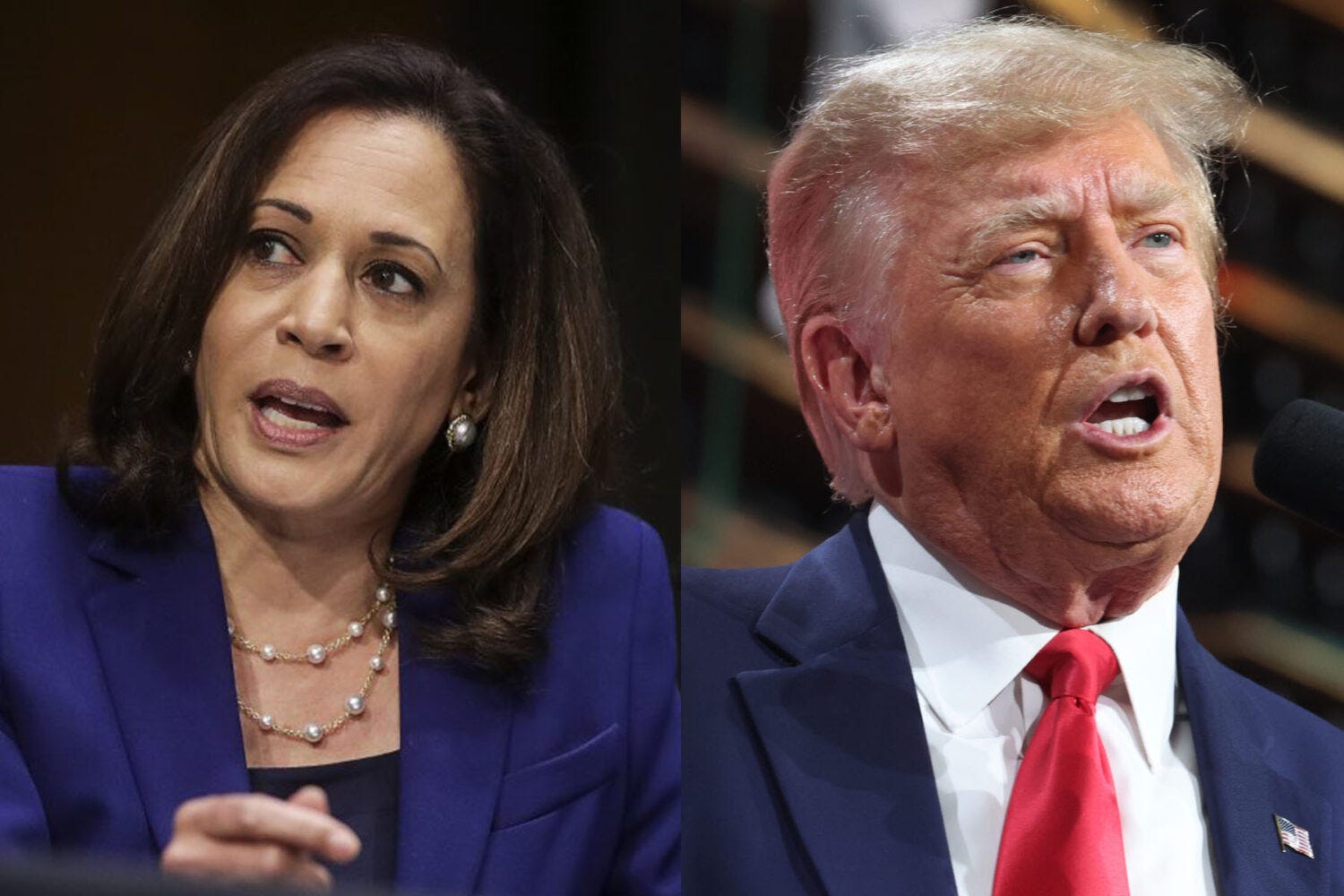
Was Vice President Kamala Harris Right About Trump—and Everything Happening Right Now?
The Warning Vice President Kamala Harris Gave on the Campaign Trail About Iran—and Why It Still Matters Today.

During her presidential campaign, Vice President Kamala Harris made a series of warnings about Donald Trump that many critics at the time dismissed as political exaggeration. But one warning stood out above the rest—clear, direct, and unsettling:
Trump’s leadership style could lead the United States into a war with Iran, a war, according to aggregated data collected by HRANA, that has murdered at least 1551 civilians, including 236 children.
At the time, it sounded like a campaign argument. Today, it feels like a question worth revisiting with fresh eyes.
The Campaign Trail Warning
While running for president, Vice President Kamala Harris consistently framed Trump as a leader who governed through impulse rather than strategy. In speeches, interviews, and debates, she painted a picture of a presidency driven by escalation, not diplomacy.
Her argument wasn’t abstract—it was specific.
She warned that Trump’s approach to foreign policy, particularly in the Middle East, was dangerously unpredictable. She pointed to his withdrawal from international agreements, his willingness to use military threats, and his pattern of personalizing global conflicts.
Iran, she suggested, was the most likely flashpoint.
Harris argued that under Trump, tensions with Iran would not just rise—they could spiral into open conflict. She emphasized that diplomacy was being replaced with brinkmanship, and that the consequences of that shift could be catastrophic.
At the time, her critics accused her of fearmongering. Supporters, however, saw it as a sober assessment of risk.
Trump’s Pattern: Escalation Over Diplomacy
To understand Harris’s warning, you have to look at the pattern she was pointing to.
Throughout his presidency, Donald Trump took a hardline stance on Iran:
He withdrew the U.S. from the Iran nuclear deal
Reimposed sweeping economic sanctions
Authorized the killing of top Iranian military leader Qassem Soleimani and Islamic leaders, such as Ruhollah Ayatollah Khamenei.
Frequently used aggressive rhetoric toward the Iranian leadership
Each of these moves increased tensions. None of them moved the U.S. closer to long-term diplomatic resolution.
Harris argued that this wasn’t just tough policy—it was a dangerous trajectory. One that could easily tip into war.
And crucially, she believed Trump lacked the restraint to stop that escalation once it began.
“He Will Start a War With Iran”
On the campaign trail, Harris didn’t dance around the issue. She made the warning in plain language:
Trump, she argued, was the kind of leader who could start a war with Iran—not out of necessity, but out of miscalculation or political instinct.
This wasn’t about one decision. It was about a pattern of behavior:
Acting without fully considering consequences
Prioritizing strength optics over strategic outcomes
Surrounding himself with advisors who reinforced escalation
She framed it as a leadership issue. Not just policy—but judgment.
And in her view, Trump’s judgment posed a direct risk of war.
Why Iran Specifically?

Harris didn’t choose Iran at random.
She understood that Iran represented one of the most volatile geopolitical fault lines in the world. Any misstep there wouldn’t stay contained—it would ripple across the Middle East and beyond.
Her concern was that Trump’s approach—maximum pressure, minimal diplomacy—created a situation where:
Tensions were constantly high
Communication channels were weak or nonexistent
Military confrontation became more likely with each escalation
In that kind of environment, a single decision—or miscalculation—could ignite a broader conflict.
That was the scenario she warned about.
Critics vs. Reality

At the time, many of Harris’s critics argued that Trump’s aggressive stance actually prevented war. They claimed that his unpredictability acted as a deterrent—that adversaries like Iran would avoid conflict precisely because they couldn’t predict his response.
This idea—often described as “peace through strength”—became a central defense of Trump’s foreign policy.
But Harris rejected that logic.
She argued that unpredictability doesn’t just deter enemies—it also increases the risk of miscalculation. And when nuclear ambitions, regional alliances, and military forces are all in play, miscalculation isn’t just dangerous.
It’s potentially catastrophic.
A Question of Leadership
At its core, Harris’s warning was about leadership style.
She contrasted her approach—coalition-building, diplomacy, measured decision-making—with what she described as Trump’s impulsive and confrontational style.
The Iran question became a symbol of that contrast.
Would the U.S. pursue stability through alliances and negotiation?
Or risk conflict through pressure and escalation?
Harris made it clear which path she believed Trump was on.
Looking at Today Through That Lens


Now, as tensions with Iran continue to dominate global headlines, Harris’s campaign warnings feel less like political messaging and more like a framework for understanding current events.
Even without a formal declaration of war, the dynamics she described back then are visible:
Persistent escalation cycles
Fragile or absent diplomatic channels
A constant risk of conflict breaking out
Whether one believes we are at the edge of a long war or already in a form of it, the underlying concern remains the same: how easily things can spiral.
And that was exactly her point.
Was She Right?
Answering that question depends on perspective—but it’s difficult to ignore how closely current tensions align with her warnings.
Harris didn’t predict specific events. She predicted a pattern:
Escalation without clear limits
Rising tensions with Iran
A leadership style that could push conflicts further, rather than contain them
Those elements are now part of the global conversation.
That doesn’t mean every outcome was inevitable. But it does suggest that her concerns were grounded in something real.
The Bigger Lesson
This isn’t just about Kamala Harris being right or wrong.
It’s about how we evaluate leadership—and the risks that come with it.
Campaign warnings are often dismissed as politics. But sometimes, they are early signals of deeper truths about how leaders think, act, and make decisions under pressure.
Harris’s warning about Iran was ultimately a warning about consequences.
About what can happen when power is paired with unpredictability.
When strategy is replaced with instinct.
When escalation becomes the default.
Final Thought
When Kamala Harris stood on the campaign trail and warned that Donald Trump could lead the United States into a war with Iran, many didn’t take it seriously.
Today, that warning feels harder to dismiss.
Not because it was dramatic—but because it was specific.
And in a world where tensions remain high and the stakes are global, the question lingers:


I am 82. I still have hopes of living long enough to once again see someone that I can respect in the White House. And I think Kamala would have done a good job as President - measured, calm, willing and able both to seek advice and to use the best of what she received.
We need a culture change in this country! Kamala Harris is a strong, capable, intelligent person. Her cabinet members and staff would have passed security clearance. They would have been qualified for their positions. Her administration might have seemed rather dull, a little wonky but it would actually be working quite well. Just like those big family dinners many of mothers and grandmothers made, no one realized the work involved to make the meal.
Yes, Kamala was right all along. Hillary Clinton was right too. But men won't listen to women. I know I've lived with a father, brothers, a husband and two sons. I also trained a man who became my supervisor. They have all questioned something I observed or did, only to say the same thing later, sometimes years later, like they just thought of it.
Our older son, proudly showed us a letter he drafted to protest the ICE murders in Minneapolis. I am very pleased that he finally realized how serious the crisis caused by the Orange Blight's regime is. But I've been writing, calling, sending postcards and emails to elected officials since the Orange Blight's first term! I almost screamed when he showed me his postcards. He acted like he discovered something new!
Sadly, it's women who expect too little of men. We clean up their messes, pick up their discarded clothes, walk on tip toes to avoid disturbing them. It's now 50 years into our marriage, it's taken years to realize he's just human. It's not my job to take care of him. He's supposed to take care of himself.
When we finally elect a woman president or the Catholic Church finally allows women to be ordained priests, it will be because the mess grew too big and complicated to undo. We'll be the cleanup crew. We had better not let them take the credit afterward.